George Floyd Mug Shot


That’s a photo from the Houston Police Department, where George Floyd was arrested in September 1998 on theft charges. Matt Berman was able to get multiple mug shots of Floyd from the Houston PD, which arrested Floyd on nine separate occasions between 1997 and 2009.

Why haven’t Americans seen these mug shots before? Berman explores this question, offering the most likely explanation: “Democrats are using this George Floyd incident to raise a lot of money, so they can’t risk having the general public begin thinking poorly of him.”

Saint George of the Blessed Fentanyl.


The Truth About Breonna Taylor, Part 1: Separating BLM’s Myth From Reality


Take a close look at those photos. They were taken Jan. 2, 2020, in the 2400 block of Elliott Avenue in Louisville, Kentucky. These police surveillance photos show a 2016 white Chevrolet Impala, with the Kentucky tag 140 ZAT. Getting out of the car is convicted narcotics trafficker Jamarcus Glover. He is exiting the Impala in front of the so-called “trap house” where he and his associates were dealing drugs.

The owner of that car was Breonna Taylor.

The Louisville Metropolitan Police Department (LMPD) was investigating Glover’s drug ring, and had just installed a surveillance camera near the “trap house” when they got that photo of Taylor dropping off her boyfriend. Barely two months (71 days, to be exact) after that photo was taken, Taylor was shot by LMPD officers executing a search warrant on her apartment as part of their investigation of Glover.

Since her death, Breonna Taylor has been turned into a sort of secular saint by Black Lives Matter (BLM) movement activists who, with assistance from the national media and Democratic politicians, have made the police shooting of Taylor a worldwide cause célèbre. In the process of making her a martyred victim of “systemic racism,” BLM and their enablers have created a myth of heroic innocence around Breonna Taylor. Over and over, we have seen photos of her in an emergency medical technician (EMT) uniform used to illustrate news features about Taylor’s death, although she hadn’t been an EMT since 2016. Celebrities and politicians have repeated the false claim that Taylor was shot while she was “sleeping in her own bed”; in fact she was in the hallway of her apartment, next to her new boyfriend Kenneth Walker, when he shot an LMPD sergeant and Taylor was shot by the officers’ return fire.

The facts surrounding Breonna Taylor’s death are important because activists have tried to make the case a symbol of “systemic racism.” After a Louisville grand jury refused to indict two of the three officers who fired their weapons during that March 13 incident, protests erupted nationwide, and these protests quickly turned violent, with two police officers shot Wednesday night in Louisville. No less a public figure than House Speaker Nancy Pelosi accused LMPD of murder: “Justice was denied for Breonna Taylor and her family. Just think if it were your daughter, your sister, your cousin, your relative, your friend who was murdered by the police and the charging decision held no one accountable for her death.” Of course, Pelosi said nothing about the fact that police didn’t shoot until after Walker had already severely wounded Sgt. Jonathan Mattingly. More importantly, however, Pelosi’s account of this “murder” omitted any reference to Breonna Taylor’s relationship with the drug dealer whose criminal activity was the reason police were serving a search warrant on her apartment that night.

Jamarcus Glover (left); Breonna Taylor (right).

Two months ago, when most people outside Kentucky had still never heard of Breonna Taylor, I wrote an American Spectator column attempting to clear up many of the myths surrounding the case:

Racism did not kill Breonna Taylor. She did not die from prejudice or discrimination. Her death was not caused by Confederate monuments or statues of Christopher Columbus, nor could her death have been prevented by social-media hashtags. If you don’t know who Breonna Taylor was, the short version of the story is that the 26-year-old was shot to death March 13 by police in Louisville, Kentucky, during a drug raid. The long version of the story is rather more complicated, but Taylor’s death has been reduced to a slogan (“Justice for Breonna”) by the Black Lives Matter (BLM) protest movement. . . .
“Say Her Name” is one of the slogans that activists have connected to this Louisville shooting, but if we want to understand why police shot Breonna Taylor, there is another name that needs to be said — Jamarcus Glover. . . .

You can read the rest of that July 27 column, which apparently was ignored by most of the public figures — journalists, politicians and celebrities — who erupted in spasms of outrage this week over the alleged “injustice” of the Louisville grand jury’s decision. The rioting mobs and TV news anchors seem to be equally ignorant of facts about Breonna Taylor’s death which I was able to report two months ago, and it is frustrating to see such ignorance continue to prevail now, when we have still more information that contradicts the BLM myth.

A Police Leak and the ‘Probable Cause’ Factor

Last month, lengthy articles appeared in the Louisville Courier Journal, the New York Times and other publications revealing details of Breonna Taylor’s association with Jamarcus Glover, including quotes from jailhouse recordings. The source of these details was a 39-page confidential report leaked by someone inside LMPD who was involved in the investigation of Glover’s drug ring. However, while quoting extensively from this report, none of these news outlets published the LMPD report itself. The only place I’ve been able to find this report in its entirety is at The Tatum Report, the website of former Tucson Police Officer Brandon Tatum. Because of bandwidth limits, a direct link to the report might cause a temporary crash, so here is the landing page and I encourage anyone who’s interested in seeing the full report to go there.

Why is this information important? Because, contrary to what was previously reported (what her family’s lawyer told the media) Breonna Taylor’s association with Marcus Glover did not end two years ago. Nor was her relationship with this convicted felon so casual that she could have been unaware of his criminal activities. In fact, LMPD detectives were entirely justified in suspecting Taylor as an accomplice in Glover’s drug ring. Evidence pointing to her involvement went beyond the information included in the police affidavit seeking a search warrant for Taylor’s apartment. The “probable cause” for that warrant was abundant.


Say hello to Quenton Se’ville “Q-Tip” Hall. In 2012, Hall was convicted of several felonies, including narcotics trafficking and possession of a firearm by a convicted felon, and sentenced to six years in prison. He served only about half of that sentence, however, and by 2016 had returned to the streets of Louisville. It was because of Quenton that police first became aware of Breonna Taylor’s connection to Jamarcus Glover.

About 7:30 p.m. on Friday, Dec. 2, 2016, LMPD officers were called to the scene of a shooting on South 25th Street. Behind the wheel of a silver sedan, police found Fernandez Bowman, 27, who was pronounced dead at the scene. Bowman had been driving when he was shot multiple times:

His car struck a telephone pole and a fence before coming to rest against a house. . . .
Including Bowman’s death, there are now 112 criminal homicide investigations by Louisville Metro Police in 2016 and 118 in Jefferson County, according to a Courier-Journal count. The toll marks a level of deadly violence not seen in Jefferson County in more than five decades.

Violent crime was increasing in Louisville, and Fernandez Bowman was one of its victims, but he didn’t own the car he died in. LMPD homicide detectives “learned that the vehicle . . . had been rented by Breonna Taylor with an address of 3003 Springfield Drive #4, Louisville, KY 40214.” How did this dead man end up in a car Taylor had rented? Early the next morning, detectives went to Taylor’s apartment:

“Upon contact with Ms. Taylor, Detectivces observed a male in the apartment with her, identified as Jamarcus Glover (DOB: 04/05/1990). Ms. Taylor stated that she did not know the victim and that she found out what had possibly happened from her boyfriend, Jamarcus Glover. Ms. Taylor stated that she had been dating Jamarcus Glover for approximately 3-4 months and allowed him to drive her rental car.”

But if Jamarcus was in her apartment on the morning of Dec. 3, how was it that Bowman had been driving this car that Taylor had rented on Dec. 1? The LMPD report says: “It is important to note that the homicide victim is the brother of Demarius Bowman, which is one of Jamarcus Glover’s associates and has been arrested with Jamarcus Glover numerous times.” So, Breonna Taylor rents a car, which she “allowed” her drug dealer boyfriend to drive, and somehow this car ends up being driven by the brother of one of Glover’s criminal associates, who gets shot to death. Two months later, LMPD arrested Quenton Hall and charged him with murdering Fernandez Bowman.

The scene where Fernandez Bowman was murdered in 2016.

What is the common-sense inference here? Doesn’t it seem likely that Jamarcus Glover needed a “clean” vehicle — a car that couldn’t be traced to him — for some drug-related enterprise? Isn’t it reasonable to suspect that Fernandez Bowman was doing some kind of deal involving Quenton Hall, and that this deal was what led to Bowman’s murder?

Well, that’s just speculation, but we know the facts about Quenton Hall’s arrest two months after Bowman’s murder:

A convicted felon wanted for an early-December murder in the Algonquin neighborhood was arrested [Jan. 31, 2017] after he fled a traffic stop and struck a police car, officials said.
Quenton Hall, 34, of Louisville, who also goes by “Q” or “Tip,” is accused of killing 27-year-old Fernandez Bowman on Dec. 2 near Algonquin Park. His arrest was announced Wednesday morning in a Louisville Metro Police in a Facebook post.
At about 7:15 p.m. Tuesday, officers stopped Hall’s white 2011 Dodge in the 4700 block of Dixie Highway because he’s “known to carry firearms and wanted for a fresh homicide,” according to an arrest citation. Hall attempted to flee and struck a police car.
Once the car came to a stop, officers found marijuana and pills in his pockets, the citation said. They searched his car and found large amounts of methamphetamine and heroin in the center console, and a loaded 9 mm Smith & Wesson handgun in the driver’s seat.
Hall was arrested at about 6:45 p.m. Tuesday and charged with murder, first-degree wanton endangerment, first-degree fleeing or evading police, first-degree trafficking in methamphetamine, first-degree trafficking in heroin, first-degree possession of a controlled substance, possession of marijuana, possession of a handgun by a convicted felon and failure to or improper signal.

We have reason to believe that Quenton Hall will spend the rest of his life in prison, and he was subsequently charged with a 2004 “cold case” murder. But the relevance of his case to Breonna Taylor is that Hall was a violent drug dealer, busted with “large amounts of methamphetamine and heroin” and a pistol two months after Fernandez Bowman was killed while driving a car that Taylor rented and “allowed” her drug-dealer boyfriend to drive. If something like this had happened to you — if your boyfriend got you mixed up in a homicide case — wouldn’t you consider that maybe you should find yourself a new boyfriend?

Yet here we see that not only did Breonna Taylor not break up with Jamarcus Glover when this December 2016 murder happened, but that she was still involved with him more than three years later, just before the March 13 police raid in which she died. People are rioting — shooting cops and throwing molotov cocktails — because of BLM anti-police rhetoric about “systemic racism” of which Breonna Taylor was allegedly a victim. Any effort to push back against this rhetoric is drowned out by angry denunciations — you are “blaming the victim” and “justifying murder” if you point to the evidence of Breonna Taylor’s complicity in Jamarcus Glover’s drug-dealing career. But how can anyone ignore this? It is the “probable cause” that resulted in the search warrant for the raid that led to her death. Police believed Taylor could be holding drugs or money for Glover, and they had clear reasons for believing this. As a matter of fact, in a jailhouse phone call after Taylor’s death, Glover said Taylor had been holding $14,000 for him.

LMPD didn’t find that money at Breonna Taylor’s apartment, but did I mention that, not long after she was seen in the 2013 Impala dropping off Glover at the “trap house,” Breonna got a new car? It was a black Dodge Charger, and it was also seen by LMPD surveillance.


TO BE CONTINUED . . .

(Support for this report is funded by reader contributions to the Shoe Leather Fund. Thanks to everyone who has contributed.)



 

I’ll Take ‘Things Not to Say to a Jersey Cop While You’re Holding a Knife’ for $400

What is “I’m gonna stab him”?

Excuse me if I took some time off from writing my long Breonna Taylor post — which I promise I will finish — in order to watch some more police bodycam videos. This one is from Asbury Park, N.J., where police responded to a domestic violence call Aug. 21. They found a woman outside, and went inside the apartment where they encountered Hasani Best, 39, who was armed with a knife and barricaded himself in a bedroom. For about 45 minutes, cops tried to negotiate Best’s surrender. The guy in charge was Sgt. Sean DeShader, a black man who in 2016 was named the department’s “Officer of the Year.”

In the bodycam video released this week, you hear Best ranting profanely and even telling the cops to shoot him. DeShader tries to defuse the situation, joking and laughing. This was obviously not the first time police had been called to deal with Best. In the 911 call that summoned police, a neighbor says “the couple was known for fighting physically,” and that the woman was screaming for help.

Early in the standoff, police used a taser, but it was ineffective. Over and over, DeShader tells Best: “Put the knife down and come on out.”

In the final moment, Best opens the door halfway, knife in hand, and gestures toward an officer standing to the left of Sgt. DeShader.

“I’m gonna stab him.”

One second later, DeShader fires twice.


A lot of people who have viewed this video are critical of Sgt. DeShader’s decision to fire. Best did not visibly lunge toward the officers before he was shot, but on the other hand, this encounter was happening at close range. The cops were in a hallway, with no more than five or six feet between themselves and the bedroom door. If Sgt. DeShader had waited a half-second longer, who knows what might have happened?

But a point I’ve made before: How many times does a cop have to tell you to drop the knife? What part of “drop the knife” is so difficult to understand? If a cop was pointing a gun at me, I guarantee you he wouldn’t have to tell me twice. But after repeated warnings, Best then made an explicit threat: “I’m gonna stab him.”

He chose . . . poorly.


Mostly Peaceful™ Protesters Shoot Two Police Officers in Louisville Riot


This is actually good news, relatively speaking. When I saw the mob unpacking riot supplies from a U-Haul truck (allegedly supplied by Soros-funded radical Holly Zoller), my thought was, “Uh-oh. This is gonna be bad.” Fortunately, Louisville is not Portland. There are about 120,000 black people in Louisville, but the protest mob — at least half of whom were white — was never more than a few hundred people.

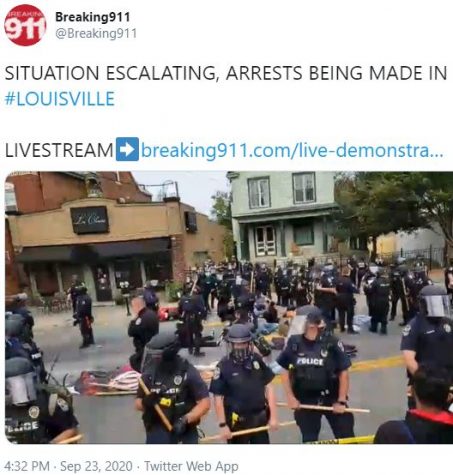
Whatever the public opinion about the Breonna Taylor case in Louisville, the vast majority of residents there clearly do not support the radical cop-hating mob, and so the city didn’t burn down Wednesday night. The cops maintained a perimeter and, when the protesters did not disperse after the 9 p.m. curfew, they arrested everybody (apparently including Daily Caller reporter Shelby Talcott). All in all, the situation in Louisville was not nearly as bad as it could have been.

For me the most disturbing moment of the night — I mean, besides the two cops getting shot — was when I briefly watched CNN and had to listen to Ben Crump run his mouth for a couple of minutes.

If any sociologist is interested in researching the cause of racism in America, there it is — Ben Crump. I defy any white person to listen to Ben Crump for two minutes without having racist thoughts. The very idea that some college gave this fool a law degree? That’s got to be worth a few thousand recruits a year for the neo-Nazis. Meanwhile . . .

Organized hatred is a frightening thing to behold, and no one can blame Americans for being terrified by what happened Wednesday in Louisville. After it was announced that a grand jury had indicted only one of the police officers involved in the death of Breonna Taylor, an angry mob began shouting threats punctuated with obscenities. “We didn’t get it! Burn it down!” was one of the threats. Another voice in the protest mob was still more specific, shouting at police: “All y’all get ready to f***ing die!”
There followed the inevitable confrontations between police and the “mostly peaceful” protesters, who engaged in vandalism and arson. By 8:30 p.m., Louisville police reported that one officer had been shot in a confusing scene on East Broadway near the Interstate 65 overpass. Subsequently, it was reported that two officers had been shot, which perhaps the #BlackLivesMatter (BLM) movement will consider adequate to satisfy their slogan of “Justice for Breonna.” . . .

Read the rest of my latest column at The American Spectator.


Louisville Democrat Mob: ‘Burn It Down’ After #BreonnaTaylor Grand Jury Ruling


The Mostly Peaceful™ Protesters didn’t wait for dark to start breaking windows in Louisville, and I expect it to get much worse after nightfall:

Protesters vowed Wednesday to continue their fight for racial justice after learning that just one of three Louisville Metro Police officers who shot into Breonna Taylor’s apartment will be criminally charged in her death.
In an afternoon announcement, Jefferson County Judge Annie O’Connell said a Jefferson County grand jury has indicted former detective Brett Hankison on three counts of first-degree wanton endangerment.
The grand jury declined to bring charges against Sgt. Jonathan Mattingly and detective Myles Cosgrove, who were also involved in the March 13 shooting at Taylor’s south Louisville apartment. . . .
Louisville police had set up a 25-block perimeter downtown, and protesters walked straight out of the area. . . .
A crowd of about 300 continued to march down Kentucky Street, stopping once to reorganize. Some people made phone calls asking others to join.
Chants included: “Keep going” and “If we don’t get (Justice), burn it down” before the group turned right onto Shelby Street. . . .
The march reached Bardstown Road at about 3:30 p.m. and began moving south down the usually busy street lined with local businesses. A few people came outside businesses to raise their fists in support of the protesters. Others were seen locking the doors to their storefronts. At least one window was smashed. . . .
LMPD officers, who had been following protesters at the front and back of the march, lined up on Bardstown Road to block the crowd from moving any further. . . .
Immediately following the confrontation with police on Bardstown Road, multiple protesters were arrested, though it’s not clear how many.
About 75 police officers in riot gear remained on the street and taped off part of the road, blocking off Bardstown entirely a few blocks from its intersection with Cherokee Parkway.

Looking at the map of Louisville, I don’t know why the protest march would be headed that direction. Was there some site they aimed to reach? Cherokee Parkway goes north to I-65, and maybe the police roadblock was intended to keep the mob off the Interstate. Here’s a quote:

“People are heartbroken, and they’re pissed the f*** off, and I am too,” protester Logan Cleaver said. “Of course I hope that people get home safe and they can get home to their families at night, but I know people are mad, and they want s**t f*****d up. And to be honest, this place should burn tonight, tomorrow night and the night after.”

That’s your Democratic Party 2020 platform.


‘The New Zeroeth Amendment’ and the Predictable Death of Dijon Kizzee


If your life’s ambition is to die in a hail of police gunfire and become a martyr for the #BlackLivesMatter movement, Dijon Kizzee is an admirable role model. The media’s role in the BLM movement is to create and sustain martyrdom myths by obscuring certain crucial facts involved in the deaths of the criminals they elevate to secular sainthood. Thus, in headlines, Dijon Kizzee becomes an “L.A. cyclist,” as if he was killed — murdered by police! — for the crime of riding a bicycle while black. Anyone disputing that false narrative is then condemned as a racist.

What you will not be told — what the CNN coverage will deliberately avoid telling you — is that Dijon Kizzee was a convicted felon who had been in and out of prison for years, that he was under a restraining order at the time of his death, and that he was carrying a stolen pistol when he encountered police who sought to question him.

Liberals are always telling us how we need “common sense” gun-control laws to “keep guns off the streets.” One such law is the prohibition of felons possessing firearms. Is there any Democrat who wishes to argue that it’s OK for convicted felons to carry loaded pistols? No, of course not. But whenever cops try to arrest felons for violating such laws, we are subjected to lectures about “systemic racism” when the criminal resists arrest and, predictably, dies in a hail of police gunfire.

Let’s start with the facts, which are buried deep in a Los Angeles Times feature profile of Saint Dijon of the Blessed Bicycle:

He was convicted for various crimes in L.A. and Kern counties over the last decade and served two terms in state prison totaling more than a year between 2016 and 2019, according to officials. The prison terms related to charges including evading or attempting to evade a peace officer while driving recklessly, as well as possession of a firearm by a felon or addict.

That’s the 14th paragraph of a 29-paragraph story. You see that Kizzee was well aware that it was illegal for him to possess firearms. If the cops caught him with a gun, he was going back to prison. So when he came in contact with the police on Aug. 31, Kizzee resisted arrest and was shot, police say, when he reached for the pistol.

We may surmise that the reason he was riding a bicycle Aug. 31 wasn’t because he was seeking the cardiovascular benefits of exercise, but rather because his history of reckless driving meant that he didn’t have a driver’s license. The media wish us to believe “systemic racism” caused Kizzee’s death; therefore, his criminal record is buried in the 14th paragraph of the L.A. Times story, and not even mentioned on CNN, which will never have a panel discussion about how cops are supposed to keep guns off the streets — a goal that liberals say they support — if “activists” organize a riot every time cops try to arrest anyone who isn’t white.

Steve Sailer described this last month during the Kenosha riots:

Egged on by Joe Biden and Wisconsin governor Tony Evers, a mob of Black Lives Matter rioters has been burning down Kenosha, Wis. They are angry over the latest police shooting of yet another black criminal who assumed he is racially entitled to resist arrest.
The new Zeroth Amendment to the Constitution reads “No Black man must submit to being arrested if He’s really not in the mood to be arrested.” . . .
One of the matters the cops may have wished to speak to [Jacob] Blake about was his open warrant for felony sexual assault. But in 2020, if he’s not interested, a Black man doesn’t have to discuss his warrant with nobody.
So, Blake fell to brawling with the police. Eventually he was tased, but without apparent effect. When he got up, a policeman pointed his gun at the 29-year-old security guard to encourage him to desist. But instead of complying, he strode around to the driver’s side of his vehicle, as the police shouted to him to “Drop the knife!” He opened the door and reached in, at which point the cop grabbing his shirt shot him seven times.

Sailer then makes reference to Blake’s 2015 charge of resisting arrest after he brandished a pistol in a Racine bar. The charges were dropped in that case, apparently because witnesses were uncooperative, but you see Sailer’s point about “the new Zeroeth Amendment.”

If someone like Blake cannot be arrested — he was violating a restraining order and terrorizing the woman who accused him of sexually assaulting her — then who, exactly, are police allowed to arrest? Are only white people subject to arrest in 21st-century America? You can talk all you want about the need for “criminal justice reform,” but the real goal of the BLM movement is to make it practically impossible to arrest anyone who is black, no matter what crimes they may have committed.

This is what happens when you elect Democrats. No one who actually wants to reduce crime would ever vote for Democrats, who rely on the votes of criminals — that’s why Mike Bloomberg is paying the fines of convicted felons in Florida — in order to win elections.


Who Votes for Democrats?


Do me a favor and post this to your Facebook page, or send the link by email to your Democrat friends, to help them understand why it is so wrong for them to vote to elect liars and fools like Chuck Schumer and Alexandria Ocasio-Cortez. See, that’s the thing about the Trump era — President Trump is an easy man to dislike, which means that no Democrat ever has to explain their vote against Trump. Because we live in a two-party system, however, our choices are binary and a vote against Trump is necessarily a vote for Chuck Schumer, one of the most infamously dishonest politicians in American history.

Look at the photo above, which is a screenshot from the video (below) of a Sunday press conference in Brooklyn where Schumer and AOC were arguing against appointing a new justice to replace Ruth Bader Ginsburg on the Supreme Court. What do you notice about that photo? Both of them are wearing masks. Why? To prevent the spread of COVID-19.

The problem with this explanation, however, becomes apparent if you’ll take time to watch the entire 14-minute video. At the beginning, Schumer is speaking without a mask, while AOC stands to his right, wearing a mask. At about the 4:30 mark, Schumer introduces AOC, who removes her mask as she steps to the rostrum and begins speaking. She blathers on until about the 8-minute mark, at which point Schumer comes back to the rostrum, this time wearing a mask. Schumer talks for about three minutes, then AOC returns to the rostrum at the 11-minute mark, without removing her mask. So then for the next three minutes, both Schumer and AOC are wearing masks while they answer questions.


Who was being protected by this, and how? I think everybody watching this pathetic charade could see that the wearing of masks by these two Democrats had zero public-health value, and was entirely a matter of political symbolism. Were Schumer and AOC concerned about the possibility of infecting each other? I think not. As a matter of fact, I doubt either of them were wearing masks except when in sight of the cameras. But if either of them was at risk of transmitting the virus to anyone else, then why did they take off their masks to speak in the early part of the press conference, while wearing their masks later?

This press conference was held outdoors, where the risk of transmission was near-zero, and the cameramen and reporters were all at a proper “social distance” from where Schumer and AOC were speaking, so again I raise the question: Who was being protected and how?

Also, did you notice the type of masks they were wearing? Both of them could certain afford (and have access to) proper medical masks, the disposable paper type, or else a full N95. Instead, they were wearing cheap cloth masks which provide very little real protection.

By the way, I’m not an anti-mask fanatic. Like, I understand that when it comes to people working retail jobs, even a marginal reduction of disease transmission risk is beneficial. I don’t much mind being required to wear a mask when I go to Sheetz or Wal-Mart, because I understand that the people who work there are exposed to hundreds of customers daily, and so anything that reduces their risk of catching the virus from their customers helps keep the business operating. Even if requiring masks affords only partial protection, I don’t begrudge retail workers that small measure of protection. It’s not about keeping me “safe,” it’s about keeping them on the job. But none of those arguments apply to the mask-wearing behavior Schumer and AOC exhibited at this press conference.

Nobody was protected from anything. In terms of contagious-disease containment, this was a textbook example of uselessness, which is par for the course for New York Democrats, both generally and in the specific context of how the state has bungled its COVID-19 response. New York City is quite literally the worst place in the world, in terms of its per-capita death rate from the Wuhan virus, and yet the Democrats who run the city and the state have never stopped congratulating themselves, while absurdly blaming all their problems on Trump.

If you listen to New Yorkers, they expect you to believe that the mass-murdering Grandma-killer Andrew Cuomo has been a complete genius in coordinating the state’s COVID-19 response, and let’s not forget the continuing blunders of NYC Mayor Bill de Blasio, who has single-handedly caused a mass-exodus from the Big Apple. Basically anyone in New York City who can afford a U-Haul truck has already left, and yet the Democrats who have run the city into the toilet are telling the rest of America we should trust Chuck Schumer and AOC to run the country.

Hate Trump all you want, but the idea that people like this deserve our trust — that they can be trusted to responsibly exercise power — is so preposterous no intelligent person could believe it.


‘Criminal Justice Reform’


There wasn’t much left of the car after the high-speed chase ended in South Carolina, and not much left of the driver, either. Behind the wheel of a stolen Toyota Prius, Kamontie Gross, 19, led police on more than a 20-mile chase April 18, 2019, from Charlotte, North Carolina, after he and two accomplices committed an armed robbery. Police from Charlotte backed off the chase, letting a police helicopter track the stolen vehicle down I-77 to the border, where South Carolina state troopers took up the pursuit. At one point, troopers used a PIT maneuver to spin the car around, but it kept going until its fiery conclusion near Rock Hill.


You will probably not be surprised by this information:

According to Mecklenburg County Jail records, Gross had been arrested nine times since 2016. Four of those arrests included charges related stolen vehicles.
Jail records also show [Gross’s 17-year-old accomplice Aniya] Taylor had been arrested seven times since 2017. Her arrests also included several charges for Possession of a Stolen Vehicle, as well as Fleeing or Eluding Arrest with a Motor Vehicle.


Between them, these two teenagers had 16 arrests, and while I couldn’t find the name of the third suspect, who survived the crash, we can imagine that this person had his or her own string of arrests. Why weren’t these criminals already behind bars? What is going on in our criminal justice system, when repeat offenders are being turned loose to wreak havoc on our streets, endangering public safety? The media amplify complaints from activists who say “mass incarceration” is the problem, but it seems to me the problem is rather the opposite. Authorities appear reluctant to lock up young criminals; grand theft auto used to be considered a serious crime, but now it’s just a videogame title, I guess.

A TV reporter interviewed Kamontie Gross’s mother:

Channel 9’s Tina Terry spoke with the mother of the man behind the wheel, who said she waited for hours at the hospital before learning that her oldest child had died in the crash.
“It’s so hard to lose a child. It’s so hard, it’s so hard,” Chaquia Gross said.
The crash killed her son Ka’Montie Gross, who was behind the wheel, an unnamed passenger, and seriously injured a second passenger.
Chaquia said she has no idea where her son was going or why any of this happened, but she said her friend messaged her about the crash shortly after it happened.
“I was like ‘Is he OK?’ They said ‘He’s gone’ and I’m like ‘What,'” Chaquia said. “She said ‘I can’t, I can’t let you see him, if you did you wouldn’t recognize him.”
Chaquia said her son had a big heart that cared for others, but he never extended that same care to himself.
“He’d tell you don’t walk across the street cause a car coming, he’d walk,” Chaquia said. “If you were down, he would pick you right back up. We might clash, but I love him to death. I’m gonna miss him.”

Oh, he “had a big heart,” when he wasn’t stealing cars, perhaps. The reader will probably not be surprised to learn that, according to jail records, Chaquia Gross was arrested on charges of breaking and entering a motor vehicle and larceny about six weeks before her son’s death. According to records, Chaquia Gross was born in June 1984 and her son Kamontie was born in June 1999, before his mother’s 15th birthday.

Go ahead and blame “systemic racism” for this.