
‘An Epicenter of Anti-Trans Violence’


Once the “social justice” bandwagon of identity-politics victimhood gets rolling, everybody starts trying to climb aboard:

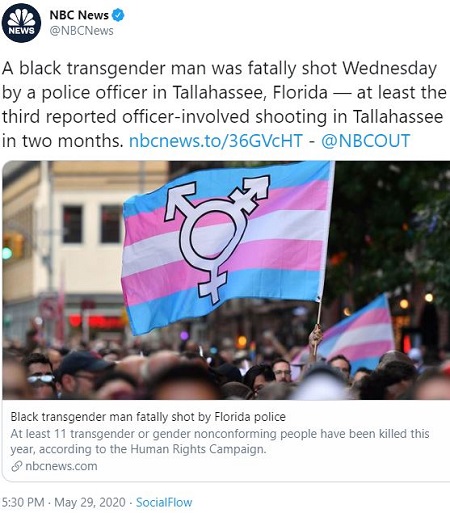
A black transgender man was fatally shot Wednesday by a police officer in Tallahassee, Florida — at least the third reported officer-involved shooting in Tallahassee in two months.
The victim, Tony McDade, 38, was identified as a suspect in a reported stabbing the morning of his death. Police said McDade fled the scene of the stabbing on foot before officers arrived, but they encountered McDade nearby shortly afterward.
According to police, McDade reportedly had a handgun and “made a move consistent with using the firearm” against an officer, prompting the officer to shoot McDade.
The Tallahassee Police Department said that it is investigating and that the officer, who was not identified, has been placed on administrative leave. . . .
Equality Florida, a statewide LGBTQ advocacy organization, said McDade’s death further exemplifies that Florida is “an epicenter of anti-trans violence.” At least seven black transgender people were murdered in Florida over the last two years, according to the organization.
Following McDade’s death, the National Black Justice Coalition said the “tragic incident should be a reminder that hate crimes against Black LGBTQ” people happen “too frequently” and “often without the national public outcry that our cis and/or heteronormative brothers and sisters receive.”
“It is important to highlight the too often ignored violence that members of our community face in addition to the discrimination we may experience because we are Black,” the coalition said in a statement.”

Are you . . . skeptical of such claims? Are you less than 100% confident this incident was a “hate crime”? Do you doubt Florida is actually an “epicenter of anti-trans violence”? Do you suspect that “Tony” McDade might not be an entirely innocent victim? Because you’re a hater?
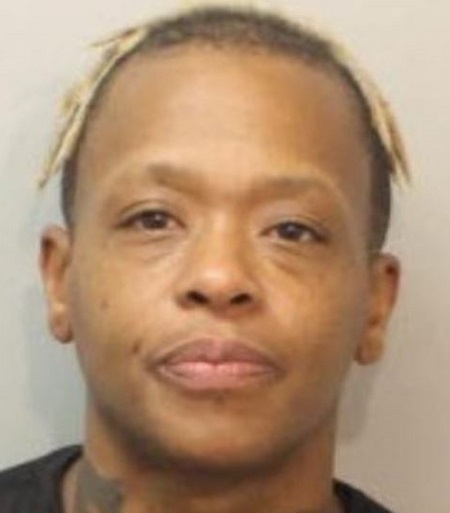
 

A Tallahassee resident shot and killed by police Wednesday vowed they would never return to federal prison in a haunting Facebook live video posted the previous day.
Natosha “Tony” McDade, 38, died after a confrontation with police on Holton Street. Officers tried to stop McDade in connection with a deadly stabbing on Saxon Street minutes earlier.
“It’s just Tony the Tiger all alone coming for your blood,” McDade said in the Facebook Live post, “And after I get through killing you (expletive) I’m going to go back on live if I have the opportunity, because I will not be going back to prison.”
“Me and the law will have a standoff,” McDade said, “Because I’m fed up.”
The Bureau of Prisons website shows McDade was just released from federal prison on January 17, 2020 after serving a ten year sentence on weapons charges.
McDade was indicted by a federal grand jury in 2009 for possession of a gun and ammunition by a convicted felon. Federal court records indicate McDade was sentenced to 10 years in prison on those charges to be followed by three years of supervised release.
“All I ask of you is to make sure my mother is fine once I depart,” McDade said in the Facebook Live post. “I am killing and going to be killed because I will not go back into federal prison.”
Leon County court records show that McDade was arrested a few weeks ago after a confrontation outside the Circle K on South Monroe Street in which a woman claimed McDade threatened her and pulled a gun on her.
The arrest affidavit dated May 4, 2020 says officers later talked with McDade, who admitted the two had argued outside the Circle K but told officers the gun in question was a BB gun. The affidavit says officers found that BB gun under the driver’s seat of McDade’s car saying it was “nearly identical to an actual firearm and was only determined to be a BB gun upon closer inspection.”
Leon County court records show McDade was charged with aggravated assault and released on bond the next day.
Leon County court records show McDade had several prior arrests between 1999 and 2009 including arrests for armed robbery, battery and forgery. Florida Department of Corrections records show McDade did two stints in state prison including five years on the armed robbery charge.

So, a career criminal, out on bond for an aggravated assault charge, who had vowed never to go back to prison and warned of a “standoff” with police, and who had just stabbed somebody to death, got killed in a confrontation with police. In what sense is “Tony” the victim here?

But this is how “social justice” works. Merely by being a member of a particular category, you’re automatically a victim, no matter what happens, and everyone is required to play along with this victimhood narrative, or else they’re guilty of “transphobia” or racism or whatever.


‘Fact-Based Truth’: MSNBC Demonized Ron DeSantis; Where’s the Apology?


Mike Barnicle, Morning Joe, Monday, March 23:

“Joe, if you talk to a lot of experts — I was fortunate enough to spend most of Friday afternoon around one of the greatest hospitals in the world, Brigham and Women’s here in Boston — you find out their view of what they’re looking at and what they’re dealing with every day. And in the case of Governor DeSantis of Florida, he’s going exactly the opposite way from what the experts, the people on the front lines, indicate ought to be done. The first thing we need is the fact-based truth from public officials. That’s what they will tell you. You get it here in Massachusetts from Charlie Baker, you’re getting it from Andrew Cuomo in New York, Gavin Newsom in California, the governors of Illinois and Michigan, and you’re getting fact-based truth.”


So, according to Mike Barnicle, the “experts” were agreed that Florida Gov. Ron DeSantis was doing the exact opposite of what was needed to fight the coronavirus pandemic. Barnicle specifically contrasted Florida’s governor to the governors of Massachusetts, New York, California, Illinois and Michigan, where “fact-based truth” allegedly prevailed.

Well, where are we now, more than two months later? How did Barnicle’s “expert” opinion fare? Here are the per-capita coronavirus death rates (deaths per million residents) for these states:

New York ………………………. 1,519
Massachusetts ………………… 950
Michigan ………………………… 534
Illinois ……………………………. 400
Florida …………………………… 108
California ……………………….. 100

So, Florida’s death rate has been 93% lower than New York, 89% lower than Massachusetts, 80% lower than Michigan, 73% lower than Illinois. The only state named by Barnicle that has done better than Florida in terms of its COVID-19 death rate is California. Given that Barnicle is such a proponent of “fact-based truth,” doesn’t it seem to you that the viewers of MSNBC deserve an explanation of why he got this so wrong?

Keep in mind that on March 23, when Barnicle was busy smearing Ron DeSantis and the MSNBC chyron declared that Florida’s coronavirus cases had passed the 1,000 mark, Massachusetts had only 777 known cases. Two weeks later, however, the situation had reversed, with Massachusetts reporting 15,202 cases on April 7, when Florida had 14,707 cases. Now? Massachusetts has 94,220 cases and 6,547 deaths, compared to 52,634 cases and 2,320 deaths in Florida — almost twice as many cases, and nearly three times as many deaths, despite the fact that Florida’s population (21.5 million) is more than three times larger than the population of Massachusetts (6.9 million).

(Hat-tip: David Rutz, Washington Free Beacon.)


U.S. Coronavirus Daily Deaths Have Decreased 43% in the Past Four Weeks


Since peaking April 21, the daily number of U.S. deaths from COVID-19 have decreased from an average of more than 2,000 per day to fewer than 1,200. This decrease has been mainly due to sharp reductions in the rate of death in the two hardest-hit states of New York and New Jersey.

During the week of April 20-26, there were 14,511 coronavirus deaths in the United States, a daily average of 2,073. During the week of May 18-24, there were 8,315 deaths, an average of 1,188 daily. During this period, the combined total of COVID-19 deaths in New York and New Jersey declined from 5,713 (April 20-26) to 1,639 (May 18-24), a 71% reduction. These two states have the highest per-capita coronavirus death rates in the country, and have accounted for 40% of all U.S. deaths from the disease during the course of the pandemic. The declining death rates in New York and New Jersey, however, mean that during last week their combined deaths were just 20% of the U.S. total.


As Professor Glenn Reynolds pointed out, data about the pandemic has been interpreted to reflect negatively on Republican-controlled states. Whereas the daily death rate in districts with Democrat representatives in Congress have declined sharply from an April peak, the rate in Republican areas — which has always been much lower — has “remained relatively steady,” according to a Pew Research analysis. Yet the fact is, despite this trend, the rate in Democrat districts is still nearly three times higher than in GOP districts. The huge spike of deaths in New York and New Jersey in March and April is the remarkable anomaly in the data, rather than the low, but “relatively steady,” death rates elsewhere.


May Is Mental Health Awareness Month, and Crazy People Are Dangerous


Last week, a shocking video went viral showing a young black man brutally beating an elderly white man. James Woods posted the video to his Twitter account, and even President Trump took notice. Online sleuths using face-recognition software quickly identified the suspect as 20-year-old Jaden Hayden, and linked him to social-media accounts with bizarre racial rants:

Content Hayden had previously uploaded to his YouTube channel suggested he holds black supremacist beliefs.
“The black race is the chosen race, the black race was supposed to rule the earth, but now…they have to go to the white man for everything and that’s not good,” Hayden says in one video.

Hayden had also reportedly uploaded other videos showing him attacking elderly white people and, according to his father, was being treated for mental health problems in Washtenaw County — the Ann Arbor area — before being diagnosed with COVID-19, and being transferred to the Detroit-area nursing home where the attack occurred:

The suspect’s father, who asked not to be named, said his son has mental health issues and a pending assault case in Washtenaw County and should never have been placed in the nursing home.
“He has issues and for them to put him in a facility like that, nothing good was going to happen,” the suspect’s father told 7 Action News.
He said his son was recently moved to the nursing center because the 20-year-old was diagnosed with COVID-19 at the University of Michigan Hospital.
The father said he’s been working with Washtenaw County Mental Health Services to get his son the help he needs and that he was placed in a group home in Chelsea. But, recently, he said his son began hearing voices and that’s when he was taken to the hospital and it was there he says that his son was diagnosed with COVID-19.
“He never should have been housed… quarantined with the victim that he eventually assaulted. That should have never happened,” he said. “Someone dropped the ball.”

Why am I thinking about the title of a 1974 Richard Pryor album?

Never mind — the point made by many people on Twitter was that, if something like this had happened with the races reversed, CNN would be in 24/7 coverage mode, and the liberal media wouldn’t be satisfied until they had whipped up enough anger to spark a deadly riot. As it is, of course, most of the media are ignoring this incident, and certainly none of them are suggesting that the actions of Jaden Hayden represent any widespread danger. Whereas, by contrast, we are told by the media that incidents like the death of Ahmaud Arbery are socially significant, as if no black person is safe from such violence. The media’s distortions of reality — white on black violence is actually rather rare — probably play a part in inciting the kind of paranoid racial resentments that may have inspired Jaden Hayden’s crime. His posting of hateful video rants suggest that Hayden’s mental illness had a racial aspect, and it is fortunate that he is now in custody. Just imagine what might have happened if someone like that had gotten his hands on a firearm. It’s scary.

Meanwhile, we can report that the victim in this attack, 75-year-old Army veteran Norman Bledsoe, is recovering from his injuries, and Hayden has been charged with assault and larceny.


‘A Team of Editors’


This is going to become the stuff of legend, so I wanted to take note of it: The New York Times decided to devote the entirety of its front page to a list of 1,000 names of COVID-19 victims. It’s Memorial Day weekend, and we are at or near the 100,000 mark in terms of nationwide death toll from the virus so . . . Well, there was some rationale for this, anyway, and the New York Times staff devoted hours to the project:

Simone Landon, assistant editor of the Graphics desk, wanted to represent the number in a way that conveyed both the vastness and the variety of lives lost. . . .
“We knew we were approaching this milestone,” she added. “We knew that there should be some way to try to reckon with that number.”
Putting 100,000 dots or stick figures on a page “doesn’t really tell you very much about who these people were, the lives that they lived, what it means for us as a country,” Ms. Landon said. So, she came up with the idea of compiling obituaries and death notices of Covid-19 victims from newspapers large and small across the country, and culling vivid passages from them.
Alain Delaquérière, a researcher, combed through various sources online for obituaries and death notices with Covid-19 written as the cause of death. He compiled a list of nearly a thousand names from hundreds of newspapers. A team of editors from across the newsroom, in addition to three graduate student journalists, read them and gleaned phrases that depicted the uniqueness of each life lost . . .

Scarcely five minutes after their list was published, people on Twitter began pointing out an obvious error: Jordan Haynes, 27, of Cedar Rapids, Iowa, was the sixth name on the Times list, but he did not die of COVID-19. He was a homicide victim, whose body was found in a car in a wooded area near Interstate 380. Exactly how the “team of editors” made such a colossal blunder, we don’t know, but they’ve deleted Haynes’ name from the list and promised to publish a correction tomorrow.

By the way, if the Times wished the list to be representative of the U.S. coronavirus toll, at least three-quarters would be over 65 years of age, and about 52 percent would be from four states — New York, New Jersey, Massachusetts and Michigan — with the highest death tolls. Iowa? With only 449 reported coronavirus deaths, the Hawkeye State is not even a full percentage point of the death toll, but 0.45%. If the “team of editors” needed the names of four or five dead Iowans to represent this, in a list of a thousand names, how was it that they chose this homicide victim? And if they can blunder so badly in this, what else do they get wrong?


Further Developments


The October 2018 murder of Univerity of Utah student Lauren McCluskey is a topic I’ve blogged about before (“An Apparently Consensual Relationship”), but I hadn’t followed further developments in the case. The man who murdered McCluskey, convicted sex offender Melvin Rowland, shot himself to death a few hours after the murder, and you might think there could be no further developments. However, officials and reporters kept probing the chain of failures that led to McCluskey’s murder, and it is a very long list indeed:

Sept. 2, 2018: Lauren McCluskey met Melvin Shawn Rowland at London Belle, a Salt Lake City bar where he was working as a bouncer, and began a relationship with him. He gave her a false name and age, and didn’t disclose that he was a convicted sex offender on parole. He visited her often at her residence hall and quickly built friendships with other students in the building. Later that month, she went pistol shooting with Rowland and his friends; as a felon, Rowland was not allowed to possess a gun. . . .

Oct. 9: McCluskey learned Rowland’s real identity — including that he had lied about his age, 37, and not disclosed that he was a registered sex offender — in the first days of October, and briefly went home to Pullman, Wash. On Oct. 9, she invited Rowland to her dorm room, confronted him with the information, and broke off their relationship. He admitted his sex-offender status, but denied the age difference. McCluskey allowed him to spend the night in her room and borrow her car the next day to run errands. She began receiving text messages, purportedly from Rowland’s friends; some urged her to kill herself. . . .

Oct. 13: At 9:22 a.m., McCluskey again contacted university police, reporting she had received more messages she believed were from Rowland or his friends. The messages demanded money in exchange for not posting compromising photos of McCluskey and Rowland online. McCluskey said she sent $1,000 to an account as demanded, in hope of keeping the photos private. She spoke to an officer by phone, then in person, then by texts, and eventually called the Salt Lake City police department, which referred her back to campus. Chief Dale Brophy said police took the report, pulled Rowland’s criminal history — but did not learn he was on parole — and assigned a detective to follow up later on possible charges of sexual extortion. . . . “There was never an attempt by any of the officers involved to check [Rowland’s] ‘offender status.’ Further, there were no policies or procedures that required such checks.” . . .

It goes on from there, including the fact that the company that employed Rowland as a security guard had hired him under a false name (“Shawn Fields”) and had not run a background check. There were so many things wrong here, to say nothing of McCluskey’s poor judgment. She was 21, and probably a lot of 21-year-olds think of themselves as savvy enough to handle themselves in any situation, but like most college kids, she was not “street smart.” Rowland had obvious sociopathic traits (“He was really good at trying to say what he thought I wanted to hear,” said one woman who had briefly dated him a few months before McCluskey’s death), but McCluskey didn’t recognize those traits as danger signs.

The police handling of the case was a disaster from start to finish. Any woman who relies on police to protect her in this kind of situation is putting her life at risk. And the reason Lauren McCluskey’s case popped up in the headlines this past week had to do with the campus cops:

Lauren McCluskey explained to the officer at the University of Utah that she was being extorted over explicit photos she had taken of herself. Someone — she wasn’t certain who at that moment — had accessed her files and was threatening to release them if she didn’t hand over $1,000.
Scared by the demand, she paid the money and then sent copies of the messages and the pictures to the campus police department as evidence.
When Miguel Deras, one of the officers assigned to her case, received them, he saved the photos on his personal phone. And days before McCluskey was killed by the man who was blackmailing her, Deras showed off at least one of the images to a male co-worker and bragged about getting to look at them whenever he wanted, according to two fellow officers.

Disgusting. The whole thing is disgusting.


Dining at the Longbranch

(Click photo to see full-size)

(This is the second of two parts. Click here to read the first part.)

“Hey, somebody told me you guys were serving beer?”

“Outside service only,” said the guy who had come out of the kitchen. “We’re closed now, though.”

“When do you open?” I asked.

“Three o’clock.”

“What time is it now?”

“Two thirty.”

“We’ll wait.”

So I walked back around to the parking lot, where Kirby still had the car running. “Park it. They’re opening in 30 minutes.”

We sat down at one of the outdoor picnic tables. It was a nice sunny day — a little cool and windy, but nice. An awning shaded the tables that serve as the Longbranch Saloon’s smoking area under normal operation, but which are now the dining room due to “social distancing” rules.

(Click photo to see full-size)

Only 25 people were permitted to congregate outside, which I suppose might be a problem on a weekend night, but on a Wednesday afternoon, Kirby and I were the only early-arriving patrons, so there was no danger of us violating the health department regulations. After a few minutes, the guy from the kitchen came out to ask us what we’d like to drink.

“Do you have any beer specials?” I asked.

“Not really. Everything’s two dollars.”

“Two dollar beer! Do you have Yuengling?”

Indeed they did. So I ordered Pennsylvania’s finest lager, and Kirby ordered iced tea, because he is a professional driver.

Normally, Kirby drives a semi truck, but last summer, high blood pressure resulted in the suspension of his commercial license, and this eventually led to the decision to move him up here with our family while he recuperated. His health has been improving, and we hope in a few more months he’ll be able to resume his life on the road, but for now my brother is the professional driver of our old Nissan. So he drove us the 30-odd miles to the Longbranch Saloon and Grill, the mailing address of which is Hedgesville, W.Va., but which is actually nearest a crossroads hamlet called Johnsonville. It’s about 10 miles west of I-81 via West Virginia Rte. 901, which passes the historic Hammond House at Spring Mills, then loops down to Hedgesville, where you turn right and head west on Rte. 9 for four miles then turn left at Baxter Road. The Longbranch Saloon is about a mile down Baxter Road on the right.

Anyway, when the man returned with our beverages, I asked his name — Brian — and if the kitchen was open. Yes, and he furnished us with menus, then left us to consider our choices. After a few minutes, he returned. I ordered the cheeseburger with fries ($7.50), while Kirby ordered the jalapeño poppers ($4), and I said: “Oh, and bring me another Yuengling.” Journalism is thirsty work, and after two months of lockdown, I’d gone through that first 12 ounces with surprising rapidity.

Honestly, there are few places in America where you are less likely to contract COVID-19 than in Hedgesville. West Virginia has one of the lowest infection rates in the country, with just over 1,500 known cases so far. The Mountaineer State didn’t report its first case until March 17, and a month later still had only 777 known coronavirus cases. The peak of the pandemic, in terms of daily new cases, was April 24, when 48 new cases were reported statewide; in the past week (May 14-20), 163 new cases were reported, an average of about 23 new cases per day. So far, there have been a total of only 69 COVID-19 deaths in West Virginia, which has a per-capita death rate 97% lower than the rate in New York.

Hedgesville is scarcely a hotbed of viral contagion, although Berkeley County has been relatively hard-hit by West Virginia standards, with 245 coronavirus cases and six deaths from the disease. This is no doubt due to the proximity to Washington, D.C. (about 90 miles southeast of Hedgesville), and the county being bisected by Interstate 81.

Despite the relatively low risk of infection, “social distancing” regulations were still in effect Wednesday at the Longbranch Saloon, so we were sitting outside on this pleasant spring day. The awning-covered outdoor dining area was adjacent to a wide lawn, with a weeping willow tree, and there was a fire pit, where I suppose people huddle around on cool evenings. After a while, Kirby and I were joined by a third patron, a retiree who had come to have a mid-afternoon beer, and we made polite small talk for a few minutes before Brian returned to bring us our food.

(Click photo to see full-size)

The burger was good, and served with crinkle-cut fries. Perhaps the gourmets of New York would turn up their snooty noses as such a meal, but they can’t go out to dinner because New York is still locked down under the regime of Mayor Bill de Blasio. Probably there are lots of people in New York — not the snooty gourmet types, but regular New Yorkers — who dream of sitting outdoors near a willow tree on a spring day, enjoying a $7.50 cheeseburger plate and a cold $2 Yuengling.

It’s “almost heaven” in West Virginia, if you appreciate simple pleasures, and I was grateful for Tim Carney’s Washington Examiner column this week that alerted me to the opportunity to enjoy a meal at the Longbranch. When the cook/waiter Brian returned, I asked him if he realized that this establishment was now the most famous saloon in West Virginia, but he apparently hadn’t read Tim’s column. If you keep up with the news in West Virginia, however, the news is good:

West Virginia Gov. Jim Justice signed an executive order allowing his state to enter the “Week 4” phase of coronavirus reopening on Thursday, which will include reopening indoor dining at restaurants, malls and outdoor recreation.
Large retail stores, tanning businesses, outdoor recreation rentals and campgrounds will also be reopened.
The new order also rescinds the requirement for out-of-state travelers visiting West Virginia to self-quarantine for 14 days upon their arrival.
The governor also outlined the plans for Week 5 reopening, expected to begin after Memorial Day, which will allow bars to open at 50 percent and museums, visitor centers, zoos, spas and massage businesses to open their doors.
At the same time, the Republican governor announced the results of his initiative to test every nursing home patient in the state, the first such policy in the U.S.
In total, 22,598 people at 123 nursing homes were tested, including 8,911 residents and 13,687 staff members. This resulted in the identification of COVID-19 in 28 new facilities. Thirty-one new staff and 11 new residents were identified as COVID-19 positive.

Thousands of New York nursing home patients have died because of Cuomo’s policy, while West Virginia is the only state in the country to have tested every nursing home resident for COVID-19. Tell me again, New Yorkers, how much smarter you are than these rustic hillbillies.

(Click photo to see full-size)

We finished our meals, and Brian brought the tab — $16.50 for a cheeseburger and fries, jalapeño poppers, two beers and an iced tea. I tipped $3.50, bringing the total tab to $20. Helping the local economy, like a patriotic American. There was a deadline looming, so we bid adieu to beautiful Hedgesville and made it back home by 5. Thanks to everyone who hit the tip jar for our trip to West By God Virginia.


We Made It

(Click photo to see full-size)

When we got to Hedgesville, we turned right and the GPS on Kirby’s phone said, “Continue west on West Virginia 9 for four miles.”

“Four miles!” my brother exclaimed.

What the heck had gotten into my head, to bring us so far out into the boondocks of Berkeley County, W.Va.? I blame Tim Carney of the Washington Examiner, who reported this week that the Longbranch Saloon and Grill in Hedgesville was actually serving beer. Sitting down in a bar and ordering a beer isn’t something you would normally think of as a special experience, but these are not normal times. After two months of COVID-19 lockdown, I was craving it. As soon as I saw Tim’s article, I resolved to follow up on his scoop and, also, do my part to help stimulate the economy. It was my duty as a patriotic American.

So I rattled the tip jar and we hit the road, Kirby driving because he is, after all, a professional driver. We got off I-81 at the Spring Mills exit and turned right, headed toward Hedgesville. I had glanced briefly at Google Maps and had a general idea that the Longbranch was out in the sticks, but how far out in the sticks it was didn’t fully register until we made that right turn at Hedgesville. “Four miles!”

Kirby began humming “Dueling Banjos” and making Deliverance jokes, which is very unkind, promoting harmful stereotypes of the Appalachian-American community. But the SPLC has never objected to hillbilly jokes, so I suppose it’s OK. Westward we rolled, and Kirby said, “Now I don’t want to hear your bitching about not having a signal.” But my phone still showed a connection until, after the appointed four miles, we turned left onto Baxter Road, at which point Kirby’s phone said, “GPS signal lost.”

Fortunately, it was only another mile to the Longbranch, and after a few winding curves, there it was on the right side of the road. So I got out of the car, walked up to the front door and . . . locked.

What? Had Tim lied to me? Then I remembered what Ace had said about Carney being one of those spineless #NeverTrump cucks, and I was just about ready to believe it. We’d driven a long way for this, however, and I wasn’t giving up so easy. So I walked around to the side of the building and heard voices coming from inside. Grabbing the knob on the side door, I turned and . . . open!

Looking inside, I saw this was the back of the kitchen, not an entrance for customers. “Hello? Anybody home?”

No answer. But I headed around back, trying to see if there was anyone around, and was just about to give up when a guy came out of the kitchen.

“Can I help you?”

TO BE CONTINUED . . .

+ – + – + – + – +

Wanted to give readers the first half of the story, because you hit the freaking tip jar, but right now I’m on deadline for a column tomorrow for The American Spectator, a column that has nothing to do with taverns in West Virginia, so in the morning, I’ll pick this up where I left off.

UPDATE: Click here for Part Two of the story.