Chelsey Coyer: American Hero


Video of a news report about the reopening of a Texas beach has gone viral. The annual party on Bolivar Peninsula — “Go Topless Jeep Weekend” — was covered by Jordan James of Beaumont’s KBMT-TV, who managed to keep a straight face while interviewing Chelsey Coyer:

“We been in quarantine and like, I need to get out and party. Whoo!”

What made this an instant classic was when Chelsey said, “Wash them hands for 20 seconds and keep them clean with the Germ-X — totally!”


Now, it seems a bit cruel to point out that Chelsey apparently didn’t spend her time in quarantine riding her Peloton bike, nibbling on veggies. No, she’s a biscuits-and-gravy girl if ever I saw one. And if you watch the video, you’ll see lots of biscuits-and-gravy folks on the beach.

Say what you will about Texans, they eat good, and are evidently immune to fat-shaming. Everything really is bigger in Texas, I reckon.

You can’t keep Texans in quarantine forever, bless their hearts.

(Hat-tip: Ed Driscoll at Instapundit.)

UPDATE: This event — “Go Topless Jeep Weekend” — has grown increasingly rowdy. Last year, things got so out of control that some residents started a petition to ban the event. By the way, watching the news coverage, you’ll see that Bolivar Peninsula (named for 19th-century South American leader Simon Bolivar) is pronounced “BAH-luh-vur” by locals, whereas I would have pronounced it “BOE-luh-vahr.”

This issue of local pronunciation is common throughout the South, where names derived from Latin languages are given an Anglicized pronunciation. If you are a student of military history, for example, you know that the Georgia town of Resaca was named for Resaca de la Palma, scene of an America victory in the Mexican War. Resaca, Georgia, was the site of a 1864 Civil War battle and, reading about the battle in history books, I assumed the town name was pronounced “Ruh-SAH-cuh,” but when I moved to Gordon County as a sports editor in the late 1980s, I discovered that the locals pronounce it “Ruh-SACK-uh.” Similarly, you will find the locals in Lafayette, Georgia, pronouncing their town’s name with the emphasis on the second syllable, which isn’t how the French officer pronounced his name. Oh, and Taliaferro County, Georgia? Locals pronounced that as “Tolliver.”


The Battle of Atillis Gym


This may go down in history books as the 21st-century Concord Bridge:

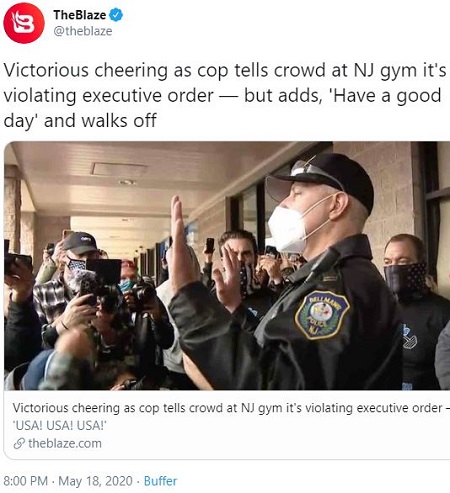
A few hours after workouts began Monday morning at New Jersey’s Atilis Gym — which is making national headlines for its early reopening in defiance of Democratic Gov. Phil Murphy’s coronavirus shutdown order — police showed up outside the Bellmawr business.
What happened next?
The large group of people outside the gym were angry and hostile, likely believing the officers showed up to shut down the gym, hand out tickets, or even make arrests. Amid the mostly unintelligible hollering, a few phrases rang out clearly:

“You have the right to refuse unconstitutional orders!”
“Freedom!”
“You swore an oath to protect our rights!”

Soon enough the crowd quieted down enough so that one of the officers was able to address them.
“We are and we’re only here for everybody’s safety today,” the officer began. “We planned for the worst, hoped for the best, and it seems like that’s what we have out here today. Formally, you are all in violation of the executive order.”
Then came the officer’s surprising follow-up statement: “On that note, have a good day. Everybody be safe.”

(Hat-tip: Ed Driscoll at Instapundit.)

In other COVID-19 news, President Trump revealed he has been taking hydroxychloroquine as a precaution, and the media freaked out:

President Donald Trump on Monday confirmed at the White House that he was taking hydroxychloroquine and zinc as preventatives against the coronavirus.
“I happen to be taking it. I’m taking it. Hydroxychloroquine. Right now, yeah,” he said.
Trump said that he had been taking the medicine for about a week and a half.
“I’m taking the two, the zinc and the hydroxy, and all I can tell you is, so far I seem to be ok,” Trump said.
He said that a doctor and many others had sent him positive letters about the effectiveness of the drug.
“I’ve heard a lot of good stories and if it is not good, I will tell you right,” he said. “I’m not going to get hurt by it.”
The president spoke to reporters about the drug on Monday afternoon at a White House roundtable with restaurant owners.
“I’m still here,” he said, saying that he had “zero symptoms” from the drug or the virus.

Predictably, CNN gave air time to Trump’s enemies to tell lies:

House Speaker Nancy Pelosi referred to President Trump as “morbidly obese” during an appearance Monday night on CNN and said he shouldn’t be taking hydroxychloroquine to stave off coronavirus.
Mrs. Pelosi, California Democrat, made the remark in an appearance on “Anderson Cooper 360” during which she was asked about Mr. Trump’s taking the drug, which he’d revealed earlier in the day.
She said taking that drug was not a good idea for the president because of his “age group and in his, shall we say, weight group,” which she described as “morbidly obese.”
The 80-year-old speaker, who is second in the presidential succession line behind Vice President Mike Pence, said she would “rather he not be taking something that has not been approved by the scientists.”
To be considered “morbidly obese,” a technical term, a person would have to be 100 pounds over his ideal body weight and have a BMI of 40 or more, or 35 or more if he also has obesity-related health conditions, such as diabetes or high blood pressure.
Those conditions would not seem to apply to Mr. Trump.
His body-mass index, according to a 2019 medical examination, is 30.4, which is considered “obese,” but not morbidly so.
At 6-foot-3, his 243-pound weight isn’t close to 100 pounds too much, and the same physical put him in “very good health overall” with a resting pulse rate of 70 and a blood pressure reading of 118/80 — all three figures well within normal range.

Ask around and see how many people over 60 are in such excellent health as President Trump. If he’s not as lean as a marathon runner, perhaps it’s because he has been too busy to go jogging lately. As to the Speaker’s assertion that hydroxychloroquine has “not been approved by scientists,” (a) the drug has been commonly prescribed for more than 70 years, and (b) many health-care workers, including nurses and doctors, are doing exactly what Trump is doing, using the hydroxy/zinc combination as preventative medicine during the pandemic. Also, as many people pointed out, if Trump is “morbidly obese,” what is Stacey Abrams?


Trust the Health Experts!


Last week, I was shocked to hear that Los Angeles was planning to be on coronavirus lockdown until August. Even if that was your plan, why would you announce more than two months of onerous restrictions so far in advance? Just extend it by two weeks now, see what happens and, if the number of new cases doesn’t meet your target, keep adding two-week extensions until you’re satisfied with the numbers. But no — August!

Trying to process this information was difficult, and then yesterday, Instapundit informed me that the person in charge of coronavirus policy Los Angeles is a former high-school principal who got a Ph.D. in Social Welfare from Brandeis. “Doctor Ferrer” is not a medical doctor, and has no real scientific expertise. She got her bachelor’s degree from the University of California, Santa Cruz, with a major in “Community Studies.” A few years ago, when she served as executive director of Boston’s Public Health Commission, “Doctor Ferrer” was featured in a CBS News program as an expert in — wait for it — teen dating violence.

Is she really the person you want running your epidemiology operations?

This business of credentialed “experts” claiming authority to run our lives has become intolerable, and the promotion of such phony expertise has become a disgrace to the profession of journalism:

Everyone in the media was horrified last month when Georgia Gov. Brian Kemp announced he would begin reopening the state’s economy. An April 21 headline in The Week denounced Kemp’s reckless “experiment,” and on April 22, MSNBC bemoaned the Republican governor’s “dangerous gamble.” Dana Milbank of the Washington Post declared: “Public health experts fear coronavirus will burn through Georgia like nothing has since William Tecumseh Sherman.” The Atlantic’s Amanda Mull went so far as to call Kemp’s move an “experiment in human sacrifice.” Yet perhaps the most memorable media condemnation of Kemp was from Ron Fournier, former Washington bureau chief for the Associated Press, who proclaimed on Twitter: “Mark this day. Because two and three weeks from now, the Georgia death toll is blood on his hands. And as Georgians move around the country, they’ll spread more death and economic destruction.”
Well, everyone did mark the day and, after Fournier’s “two or three weeks” elapsed, they called attention to how badly wrong his prediction had been. . . .

Read the rest of my latest column at The American Spectator.


‘Out-of-Towners’ Blamed for ‘Mayhem’ After Florida City Re-Opens Beach


Florida’s COVID-19 response has been a tremendous success story. Much like Georgia, where Gov. Brian Kemp resisted the Cult of Eternal Lockdown, the Republican governor of Florida, Ron DeSantis, delayed issuing a statewide lockdown order and was one of the first governors to lift the order. As I have explained elsewhere, most Florida counties were handling their own coronavirus outbreaks with local policies, so DeSantis didn’t feel a statewide lockdown was necessary, especially because there were so many counties with very few cases, but finally he gave in to the political pressure. And as soon as May 1 arrived, DeSantis was ready to go back to business. Democrats demonized DeSantis, with activist Daniel Uhlfelder touring Florida beaches dressed as the Grim Reaper to promote the message that the Republican governor’s decision would kill people.

Meanwhile, Florida residents have begun resuming normal life without a statewide mandate, which means local governments are making their own decisions. Naples, on the state’s southwest coast, opened its beach May 1, but last weekend saw such crowds that they closed it again:

The city of Naples closed its public beaches at 12:01 a.m. Sunday. City leaders said the beaches were overrun with beachgoers to start the weekend, so the move is a continued effort to stop the possible spread of the coronavirus.
According to the city press release, “In an effort to mitigate the spread of the novel coronavirus (COVID-19) and alignment with CDC guidance and Governor DeSantis’s Executive Order 20-112, the City of Naples will be closing all public beaches within city limits effective 12:01 a.m. on Sunday, May 10 until further notice.” . . .
Naples Councilman Gary Price told us he visited the beaches during [Saturday, May 9] to get a look for himself. And what he said he saw disappointed him, concerned him and caused him to make a call to the city manager about how to regain control of the beaches in the city.
“We really wanted to make sure that people were safe,” Price said. “And what I saw today is what I believe to be really not safe.”
Price took a picture while checking out the beach, and that’s what prompted him to take action, he said. Price said he saw signs that people were visiting from the east coast of the state since their beaches remain closed.
“I took some pictures of cars that were from Broward and Miami-Dade dealership plates,” Price said. “And so you could tell from the cars.”

See? It’s not the Collier County locals who caused the problem; rather, it was people traveling from the Miami area — more than 100 miles away, where the beaches are still closed — who were the problem. Three counties (Miami-Dade, Palm Beach and Broward) account for about 60% of all coronavirus deaths in Florida, and guess what else we know about those counties? Right — they’re overwhelmingly Democrat. In the 2016 election, Hillary Clinton got 57% of the vote in Palm Beach, 64% in Miami-Dade and 67% in Broward. So the lockdown of the entire state was necessitated by the high rates of infection in these Democratic stongholds. Now that the statewide order has been lifted, the beaches remain closed in the high-infection Democrat areas. This creates problems for places like Naples, in Collier County, where infection rates have been low. Would you care to guess how people vote in Naples?

You guessed it — Trump got 62% of the vote in Collier County.

Partisan affiliation correlates with lifestyle differences, which is why Democrat-dominated areas of Florida have high COVID-19 infection rates, and why Republican-leaning Naples can’t re-open its beaches without being overrun by people trying to escape from Miami:

The City of Naples has voted to reopen its beaches again but this time with some limitations.
After a grueling emergency meeting and three failed motions, council members negotiated their way to a fourth and final vote.
Naples beaches will be open sunrise to sunset, Monday through Friday, starting at 7 a.m. May 13. The beaches will have shorter hours on weekends: 7 to 11 a.m. and then closing before reopening from 5 p.m. to sunset. The weekend hours will extend to Memorial Day, too.
Coolers and tents will not be allowed on the beaches, but chairs can be used in the evenings to watch the sunset.
Parking enforcement has been beefed up with fines doubling to $200 with no option to pay early for a discount. Illegally parked cars can also now be towed.
Parking will be limited to those with beach stickers (both city and Collier County stickers are accepted) but the city will not allow parking on residential streets unless they are properly marked parking spaces.
Readers React: Facebook readers react to city of Naples public beach closures, lack of social distancing
Some council members were steadfast in trying to get shorter hours during the weekdays as well as the weekends.
“I am rigidly set on 7-day bifurcation hours,” Councilman Ray Christman said. “It seems to me that opening the beach from dawn to dusk, five days a week and not placing any limitations on activities is just further increasing the risk of having out-of-towners coming in and using the beach and creating a situation that replicated last weekend.” . . .
Only a week after the city opened the beaches to the public, the closure order was issued after a council member witnessed crowds on Saturday not following social distancing guidelines.
“My judgment call was not done hastily,” Mayor Teresa Heitmann said. “It was done with the city manager, the police chief and the fire department to make sure this situation does not get out of control. I heard descriptions of mayhem and a lack of regard to emergency orders of social distancing.”

Democrats come to town? “Mayhem!”

Beyond this problem in Naples, how is Florida faring in its return to normalcy? We were told by Democrats like Uhlfelder that DeSantis’s decision would certainly result in thousands of COVID-19 deaths, but guess what? It hasn’t happened. Three weeks ago, during the week of April 18-24, Florida reported an average of 825.7 new cornavirus daily, and 45.7 deaths daily. For the week of May 9-15, the average daily number of new cases was 644.7 — a 22% reduction — and the average daily number of COVID-19 deaths was 31.7, a reduction of 31%. Florida’s per-capita death rate from the virus is still 94% lower than New York’s.

UPDATE: Welcome, Instapundit readers!



Remember How Everybody Was Going to Die Because Georgia Ended Lockdowns?


The headlines last month were scary:

Georgia’s dangerous coronavirus experiment
— Joel Mathis, The Week April 21

Georgia’s Kemp neglected to warn people
about his dangerous gamble

— Steve Benen, MSNBC, April 22

Kemp poised to lift restrictions,
despite warnings of renewed outbreak

— Alan Judd and Greg Bluestein, Atlanta Journal-Constitution, April 29

It was a “gamble,” an “experiment,” and the media all agreed it was “dangerous” for Georgia Gov. Brian Kemp to do this “despite warnings.” You would have thought, based on the coverage, that Kemp’s plan was so reckless and irresponsible as to guarantee a “renewed outbreak” that would kill thousands. But what actually happened?

Georgia’s daily COVID-19 deaths had already peaked by the time Kemp announced he would begin re-opening the state’s economy. On April 16, Georgia recorded 52 deaths from the virus, concluding a week (April 10-16) in which the state recorded 205 deaths, an average of 35.7 deaths daily for that week. For the seven day period ending Thursday (i.e., May 8-14), Georgia recorded a total of 105 coronavirus deaths, an average of 15 daily. In other words, comparing these two seven-day periods, there was a 58% decrease in Georgia’s COVID-19 deaths. The number of daily new COVID-19 cases reported has likewise declined more than 50% since April, even as the number of tests performed has increased.

COVID-19 is a new disease. Everything we know about this virus, we’ve learned in the past six months. However, something Michael Fumento remarked last month bears repeating: Epidemics are always subject to Farr’s Law, in which cases rise and fall in a bell-curve pattern. The death toll peaks and then recedes because, in the early stages of the outbreak, the disease “grabs the low-hanging fruit” (the most vulnerable population), but eventually runs out of such victims. While quarantine policies can “slow the spread” and “flatten the curve,” ultimately no human intervention matters more than the effect of Farr’s Law.

By the time Governor Kemp announced his “gamble” in the third week of April, the number of COVID-19 deaths in Georgia had already peaked. While the number of reported cases was still continuing to rise (it did not peak until April 27, when 937 new cases were reported), this was an artifact, the result of more widespread testing, which identified asymptomatic or mild cases. Throughout the course of Georgia’s coronavirus outbreak so far, there have been 1,557 deaths and, with the daily death toll still decreasing steadily, it seems unlikely the state will experience the “renewed outbreak” that Kemp’s critics warned about.

As of 10 a.m. today, Georgia’s per-capita death rate from COVID-19 (measured in deaths per million residents) was 150, which was 88.5% lower than the state of New York’s death rate of 1,417.

Oh, and just for your information, the daily number of U.S. coronavirus deaths nationwide peaked at 2,683 — on April 21, which was 25 days ago. The highest daily number of deaths in the past week was 1,772 on Wednesday (May 13), and that number was 34% below the April 21 peak.

UPDATE: Earlier this week, Stacey Lennox said, “Dear Media, Governor Kemp Will Accept Your Apology Now.” Don’t hold your breath.

UPDATE II: Welcome, Instapundit readers! Hope you will remember that the Five Most Important Words in the English Language are:

HIT THE FREAKING TIP JAR!


She Befriended the Man Who Killed Her Mother. Guess How That Turned Out?


If you answered “not too good,” you’re a winner:

Big-hearted, gregarious and always up for an adventure, Martha McKay surrounded herself with friends.
“There was something about her that people really loved,” her sister Katie Hutton tells PEOPLE. “She left an impression on people. She had that gift.”
McKay’s family and friends were devastated when she was killed on March 25, 2020, at Snowden House, the historic antebellum-style home on Horseshoe Lake, Arkansas, she bought from her family in 2004, restored and reopened as a luxury bed-and-breakfast.
McKay, 63, was found stabbed and bludgeoned to death at the top of the stairs, near a bag filled with her belongings, as well as a utility knife.
Authorities were shocked when they pulled the body of her killer out of the lake (he’d jumped in and drowned during a police chase): it was Travis Lewis, who’d been convicted at 17 for the horrific 1996 murders of her mother, Sally Snowden McKay, 75, and her cousin, Joseph “Lee” Baker, 52, a prominent Memphis blues guitarist. . . .
Knowing how forgiving McKay was, family and friends were still shocked when she befriended him after he went to prison (Lewis was sentenced to 28 ½ years after pleading guilty). . . .
A longtime Buddhist, McKay wrote Lewis letters in prison and supported his early, paroled release.
“We were contacted every time he came up for parole,” says Hutton. “None of us would OK it except for her.” . . .
When Lewis was finally released on parole in 2018, McKay quietly gave him a job doing work on the property, Hutton says.
But before her death, she fired him. Police had heard about a theft at McKay’s house before her murder, says Crittenden County Chief Investigator Todd Grooms. After she died, Hutton read in her diary that she’d sold a chandelier for $10,000 cash, which she stashed in the house.
Travis happened to be there that day, says Hutton. “Then the money vanished. She fired him after the money disappeared,” she says.
The family is still reeling from the fact that the same man killed her sister, mother, and cousin — 23 years apart.
“We are all just in disbelief,” says Hutton.

(Hat-tip: Kirby McCain on Twitter.)


Democrat Concedes in CA-25 Special Election: Not Close Enough to Steal


Even the amazing ability of California Democrats to manufacture votes through “ballot harvesting” were not enough to elect Christy Smith in Tuesday’s special election to fill the seat vacated by naked bisexual Katie Hill‘s resignation. Republican Mike Garcia won CA-25 by a 12% margin, 56-44, an advantage of more than 18,000 votes, and Smith finally conceded Wednesday afternoon. You can add Garcia’s victory to the win for Republican Tom Tiffany in Wisconsin’s 7th District, filling the seat vacated by Republican Sean Duffy’s retirement. And how did the blog FiveThirtyEight tout this on Monday?

Two Special Elections On Tuesday
Could Hint At Another Blue Wave In 2020

For some reason, they haven’t followed up on that idea. How did they get this “bellwether” so wrong? Molly Hemingway takes a look:

The case made by Geoffrey Skelley and Nathaniel Rakich was simple: Supposedly Americans strongly prefer Biden and Democrats over Trump and Republicans, and they are particularly upset with Trump and other Republicans’ attempts to reopen the country as the global Coronavirus pandemic rages.
“On Tuesday, we’ll get a taste of whether Democrats’ electoral advantage on paper will hold up in practice, as California and Wisconsin hold special elections for two vacant congressional seats. The main event is in the California 25th Congressional District, a bellwether seat in the north Los Angeles suburbs, where both parties see a chance to add to their ranks in the House. But if Democrats are also competitive in the quickly reddening, rural Wisconsin 7th Congressional District, it could signal another blue wave in the fall,” they argued. . . .

Read the whole thing.


Transgender Person Stabbed to Death


The major media are ignoring this crime for some reason:

HRC is deeply saddened to learn of the death of Helle Jae O’Regan, a 20-year-old transgender woman killed in San Antonio, Texas, on May 6. Her death is believed to be the at least 11th violent death of a transgender or gender non-conforming person this year in the U.S., and the sixth known violent death in just over five weeks — all transgender women.
”For the past several weeks, we have learned of the violent deaths of transgender Americans at a rate that should be a shock and horror to every single person. We must all ask ourselves today: ‘What am I doing to ensure a world where a person’s gender identity is not a potential death sentence?’” said Tori Cooper, HRC Director of Community Engagement for the Transgender Justice Initiative.

Let’s get the local news story:

A 42-year old man accused of violently attacking three people inside a barbershop choked one of the victims until they passed out, then stabbed the worker to death, according to court documents.
He’s also accused of stabbing another woman several times before she ran to get help. Investigators say she was taken to the hospital but is expected to be okay.
A third employee was also inside the shop but was not hurt.
Friends came in twos and threes to the Diesel Barbershop off Bandera Road to pay their respects and celebrate a life.
Court documents identify the victim as 20-year old Evan O’Regan, known as Helle Jae O’Regan to friends.
“We’ve known her since high school and she was so sweet,” said Jazzlyn Rodriguez, a friend of O’Regan’s. “She was the kindest person.

Gosh, who could have stabbed this “sweet” young person to death?

San Antonio police arrested 42-year-old Damion Terrell Blue Campbell on Wednesday night in connection to an incident that left one person dead and another wounded at a Northwest Side barbershop earlier in the day. Campbell was charged with murder.
At around 12:15 p.m. on Wednesday, officers were called to the Diesel Barbershop in the Bandera Oaks shopping plaza for a cutting in progress. When police arrived, they found 20-year-old Evan Sorrell Ford Oregan, also known as Helle, an employee of the barbershop, laying near the back door of the business suffering from multiple stab wounds. Oregan died at the scene. . . .
The employees were taking appointments preparing for Friday when the incident occurred. After speaking outside, witnesses said Oregan and Campbell walked into the shop together to schedule an apparent appointment, according to the arrest affidavit.
Campbell told the employees he forgot his payment and left the shop to retrieve it, but returned armed with a knife and a gun and ordered the employees to the back of the business, the affidavit said.
Campbell then choked Oregan until she passed out, according to the affidavit. One of the employees was able to escape, but surveillance footage showed Campbell stabbing Harrell and Oregan multiple times before fleeing from the business, the affidavit continued.


Probably not a right-wing Trump voter:

One of Campbell’s neighbors, Robert Abraham, said given the numerous bizarre posts and confrontations between him and Campbell, the allegations were not shocking.
“It doesn’t surprise a lot of people that were familiar with him in the neighborhood,” Abraham said.
Abraham said Campbell had repeatedly confronted him and others on the neighborhood’s Facebook group. He said at one point, the communications were so concerning, his wife urged him to call the Bexar County Sheriff’s Office.
“I can’t even mentally understand it. It was quite bizarre,” Abraham said of Campbell’s antagonizing comments and posts, pointing to one in which Campbell had licked park benches, making light of the pandemic.
Other residents reached out to KENS 5, not wanting to go on camera, but echoing Abraham, stating Campbell had posted bizarre videos and comments. One video shared by a member of the neighborhood Facebook group depicts what they said is Campbell in a beak-like plague mask, driving with a siren playing in the background.
“When I kind of step back and look at it, I was like — it was quite frightening, to be honest with you,” Abraham said. “You know, in light of what happened.” . . .
Shayne Brown, the owner of Diesel Barbershop, where Campbell is alleged to have carried out the attack, described the deadly ordeal in a Facebook post.
“Attempts were made to give the man whatever he wanted…cash, equipment, or whatever it took to get him out of the shop,” Brown wrote in a Facebook post. “The man made it clear that he wasn’t there for money. He then began asking the employees: ‘What have you done wrong? What have you done wrong? God sent me here to kill you because you have done something wrong! What have you done wrong?’ over and over again while forcing them to the back of the shop.”

And the moral of the story? Crazy People Are Dangerous.