Iran’s regime executed a gay adolescent in July — the first confirmed execution of someone convicted as a juvenile in the Islamic Republic in 2016 — Amnesty International reported this week.
Hassan Afshar, 19, was hanged in Arak Prison in Iran’s Markazi Province on July 18, after he was convicted of “forced male-to-male anal intercourse” (‘lavat-e be onf’) in early 2015, the NGO said in a statement Tuesday.
Stefan Schaden, a LGBT rights activist and spokesman for the European ‘STOP THE BOMB’ campaign, told The Jerusalem Post on Thursday, “Consensual homosexual conduct remains illegal under Iran’s Sharia law and is punished with public flogging or even execution. While the Islamic State throws gays from rooftops, the Islamic Republic [of Iran] hangs them.”
Amnesty said the Iranian authorities received a complaint accusing Afshar and two other adolescents of forcing a teenage boy to have sex. Afshar, who was arrested in December, 2014, said that the same-sex relations were consensual and the accuser had freely engaged in prior homosexual relations.
“Iran has proved that its sickening enthusiasm for putting juveniles to death, in contravention of international law, knows no bounds,” said Magdalena Mughrabi, Deputy Middle East and North Africa Programme Director at Amnesty International.
She added that Hassan Afshar was a 17-year-old high school student when he was arrested. . . .
According to a 2008 British Wikileaks dispatch, Iran executed between 4,000 to 6,000 gays and lesbians between the start of the Islamic Revolution in 1979 to 2008.
Iran frequently executes gay men for same-sex relations and frames the men for rape charges to justify its Islamic law application of lethal homophobia.
Israel’s Defense Ministry harshly rejected President Obama’s remarks about the Iran deal, disputing that it no longer opposes the international agreement reached in Vienna in July of last year.
While adamantly defending the deal on Thursday, Obama said “it’s the assessment of the Israeli military and intelligence community … that acknowledges this has been a game-changer.”
In disagreeing, the Defense Ministry compared the deal to the 1938 Munich Agreement between European powers and Nazi Germany, saying that it had no basis in reality.
The statement, reportedly from Defense Minister Avigdor Lieberman, said:
“The Israeli defense establishment believes that agreements have value only if they are based on reality. They have no value if the facts on the ground are opposite to the ones the agreement is based on. The Munich Agreements didn’t prevent World War II and the Holocaust because their fundamental assumption — that Nazi Germany can be partner to any agreement — was false, and because world leaders at the time ignored clear statements made by Hitler and other Nazi leaders.”
Liberals desperately want to believe that concerns about Islamic radicalism are just “right-wing Islamophobia,” but facts get in the way.
Kudos to Virginia Thrasher, who earned the first Olympic gold medal for the U.S. this year at the Biohazard Olympics in Rio. As usual, many of the following links are to pics generally considered NSFW, so exercise discretion in your clicking, because whatever happens to you if you don’t, it’s not our problem.
“Everybody said, ‘Don’t go messing with a girl with guns!'”
Regret that my 2016 Election Primal Scream Therapy has curtailed my blogging to the point of non-existence. Keep in mind that it’s all fun and games until junk gets real, states secede and armies march.
I know where we're headed And our future's fully threaded And we'll likely soon eat Venezuelan food (1/2) https://t.co/ucp302By7t
“Medical students’ disease (also known as second year syndrome or intern’s syndrome) is a condition frequently reported in medical students, who perceive themselves to be experiencing the symptoms of a disease that they are studying.”
— Wikipedia
Question: Are young people being psychologically damaged by exposure to a cacophony of information about “gender” and sexuality?
The transgender cult has been accused by many critics of exploiting adolescent confusion, persuading emotionally disturbed young people that “transition” is a panacea, the cure for all their problems:
When will the medical and psychological professions wake up? . . .
There is an actual process of indoctrination going on on the Internet, and most liberal parents are simply unaware of its power and reach.
Alas, political correctness — backed by the authority of academia, media and powerful LGBT lobbying groups — has made it impossible for any psychologist to challenge the regnant superstition. Anyone can (and should) be whatever they want to be, all the “experts” insist, and those who oppose this agenda are accused of inciting hatred that might cause the helpless victims of “gender dysphoria” to commit suicide.
Suppose a kid is socially awkward, troubled by insecurity about their body, struggling to fit into the teenage dating scene. These are such commonplace woes of adolescence as to be almost universal. Ah, but now we have the Internet, and guess what the awkward teen finds there?
Young people who for some reason feel dissatisfied with their sex often go to reddit’s various transgender communities to ask for advice.
A 14 year old kid asks for advice on two different subreddits about how to talk to family members about gender issues and about medications like estrogen.
On one of the posts, an adult invites the 14 year old to take contact privately. . . .
In the other post, concrete advice about how to obtain prescription medication illegally is given, complete with dosages . . .
This story sounds familiar to anyone who’s been paying attention to the stories many newly trans teenagers post online. An intense period of bingeing on social media accounts of being trans leading to the teen suddenly identifying as trans themselves. . . .
Teenagers have always been struggling to fit in, to figure out who they are, to label themselves. But it’s not until now that discovering your true self involves taking hormones and getting surgery. And it’s not until now that questioning whether it is wise for teens to be getting medication advice online is bigoted.
What is going on here involves suggestibility. Young people are naïve, and when adolescent misfits are trying to figure out the cause of their unhappiness, they are particularly vulnerable to this kind of influence. Sexually confused teenagers often erect a defensive shell to conceal their inner turmoil, maintaining a “good kid” façade that prevents parents from recognizing signs of trouble. Instead, they seek answers on the Internet, where “supportive” strangers are always eager to offer advice. So you now have children as young as 13 getting amateur counseling via Reddit, Tumblr, etc., and cult is not too strong a word to describe the mentality that prevails within these insular online communities.
A brief digression: Remember the Columbine massacre? A couple of teenage weirdos started messing around in “Goth” culture, hanging out with other weirdos and, unbeknownst to their parents, hatched an elaborate plan to perpetrate a bloody slaughter at their high school. After the shootings, people were shocked that warning signs had been missed:
In 1996, Eric Harris created a private website on America Online. Harris initially created the site to host gaming levels he and his friend Dylan Klebold created for use in the video game Doom, primarily for friends. On this site, Harris began a blog, which included jokes and short journal entries with thoughts on parents, school, and friends. By the end of the year, the site contained instructions on how to cause mischief, as well as instructions on how to make explosives, and blogs in which he described the trouble he and Klebold were causing. Beginning in early 1997, the blog postings began to show the first signs of Harris’s ever-growing anger against society.
Harris’s site attracted few visitors, and caused no concern until March 1998. Klebold gave the web address to Brooks Brown, a former friend of Harris. Brown’s mother had filed numerous complaints with the Jefferson County Sheriff’s office concerning Harris, as she thought he was dangerous. The website contained numerous death threats directed against Brown: Klebold knew that if Brooks accessed the address, he would discover the content and inform his parents, and likely the authorities would be notified. After Brown’s parents viewed the site, they contacted the Jefferson County Sheriff’s Office. The investigator Michael Guerra was told about the website. When he accessed it, Guerra discovered numerous violent threats directed against the students and teachers of Columbine High School. Other material included blurbs that Harris had written about his general hatred of society, and his desire to kill those who annoyed him.
If this kind of red flag about a potential mass murder could be overlooked, how much easier is it to ignore signs that your kid is struggling to cope with adolescent sexual problems? And in the same way that Eric Harris used his America Online account as an outlet for his problems, many kids today are secretly turning to social media and online forums as a way to deal with their “gender” issues and, in most cases, parents don’t have the slightest clue of what’s going on.
One reason I have spent two years hammering away at radical feminism is that so many people are unaware of what kind of craziness is being fomented in the name of “equality.” The destruction of due-process rights in campus sexual assault investigations is an example of how extreme ideas can make their way into “mainstream” acceptance, and we see a very similar phenomenon in how the transgender cult gained influence.
Now, I didn’t always know that I was transgender. For me, it took a lot of self-exploration and discovery, not to mention countless hours of research and reading before even learning the word transgender. I went through stages: In ninth grade, I identified as a bisexual girl, but I was unfortunately outed to everyone in my small private school. I didn’t get a great reaction — some girl told everyone while I was at home sick, and when I returned the next day I was literally mobbed by questions and insults. A horde of people surrounded me and shouted obscenities at me. In tenth grade, I tried conforming to the compulsory heterosexuality that my school seemed to love at the time in a half-hearted attempt to avoid more bullying. I grew my hair out and talked about having crushes on boys because that’s what girls were expected to do; it quickly became a self-defense tactic. In eleventh grade, I publicly owned my sexuality, believing myself to now be a lesbian. I fought to start a Gay Straight Alliance at my school (and was its inaugural president the next year), and even dated a girl briefly. But none of these labels felt right to me. By the end of that year, I thought back to everything I had seen and read and realized: Oh god. That’s me. I’m transgender.
I didn’t come out until October, 2014, at the start of my freshman year of college at Florida State University. Ironically, I was placed in the all-girls dorm. My roommate was trying to figure out her own sexuality at the time, and we ended up coming out to each other the same night. We were watching the show Once Upon a Time, and I turned to her and asked, “You know how I don’t go by my birth name? Would you mind trying out different pronouns for me?” She hugged me and told me of course she would, and within a minute of returning our attention to the show, she blurted out, “I’m a lesbian.”
She and her family were incredibly supportive of me while my parents were struggling to get used to the idea; I don’t really know what I would have done without her. I ended up telling every friend I made from that moment on that I was trans, and all of them fully respected my name and pronouns.
This kind of narrative is becoming surprisingly common in recent years. Why? My suspicion — an educated guess — is that we are witnessing an unexpected consequence of a hypersexualized youth culture. Forty years ago, when I was a horny teenager growing up in the Bible Belt, we were “working on our night moves,” as Bob Seger sang, in a society where all the responsible forces of grown-up society were trying to stop us. Kids didn’t have 110 cable channels to choose from, and there were no cell phones or laptops (because Al Gore hadn’t invented the Internet yet) and information about sex was almost as difficult to obtain as sex itself. Fast-forward to the 21st century, however, and kids are growing up in a world where they are bombarded with sex — sex! sex! sex! — from every direction. Afternoon reruns of sitcoms like Friends, Seinfeld, Two and a Half Men and The Big Bang Theory are full of sex-related storylines, many primetime TV programs feature gay characters, and any kid with Internet access can find a cornucopia of hard-core pornography.
Growing up in a culture shaped by this media-driven sexual tsunami — even if you protect your kids from it, most of their peers are exposed to it — many young people are psychologically traumatized. As bad as a constant diet of sex-saturated media is for adults, what is the effect on kids trying to form their identities amid this pornographic onslaught?
Back when we were “working on mysteries without any clues,” to quote Seger again, our direct experience of sex (or, at least our hope of achieving such experience) was not so confused by the kaleidoscopic proliferation of cultural scripts with which teenager are today confronted. Whatever confusion we experienced was authentic, rather than the result of trying to conform to some prefabricated “gender identity” in the LGBTQIA Acronym Rainbow. Teenagers experimented and improvised and — here’s the important part — none of our sexual activity was approved by grown-up society. We were all wicked sinners engaged in fornication, consumed by carnal lust and, as bad as was the threat of punishment in the eternal fires of Hell, we knew we would face hell right here on earth if our parents ever caught us.
Sex was bad and dirty and wrong, and that was half the fun of it, really.
Yet here in the 21st century, Rachel Andelman felt the need to “identify” as bisexual at age 14 when, in point of fact, Florida law doesn’t even consider 14-year-olds capable of consenting to sex. By the time she was a junior, she came out as a lesbian, already sufficiently fluent in radical feminist jargon to invoke “compulsory heterosexuality” as a force of patriarchal oppression. (When I was a high-school junior, heterosexuality sure as heck wasn’t “compulsory,” or else I’d have been getting some of that action.) Whether or not Rachel Andelman ever could have been heterosexual, had a mad scientist erased her memory and transported her in a time machine to 1976, is one of those interesting questions that must remain forever in the realm of hypothetical speculation. Certainly there were many teenage girls back then who were awkward and confused, but they didn’t have the Internet to tell them what to do about their confusion, whereas Rachel Andelman did “countless hours of research and reading” before arriving at her transgender destination at age 18.
Oh, and what a strange coincidence that her freshman roommate at college was also going through a sexual identity crisis. Except it’s not a coincidence, it’s a trend. Isn’t everybody in college going through a sexual identity crisis nowadays? LGBTQIA — pick a letter! Any letter!
When I was in college, freshmen went out for Rush Week and pledged a fraternity. Now, kids pledge a sexuality. Is there a hazing initiation after you join a sexuality during LGBTQIA Rush Week?
It’s easy to joke about these kooks, but while the transgender college girl looks like a comedy from an objective point of view, can you imagine the mortification of parents whose kids get sucked into this cult? One day you have a daughter named Rachel, and then . . . Well, watch the video:
So now “Charlie” Andelman is all over the Internet. More than 2,500 people have watched that video, and another 1,200 people have watched this video in which “Charlie” shows off “his” surgically-altered chest:
As I say, it’s easy to laugh at the absurd results of this bizarre Frankenstein experiment. The “man” produced by hormones and surgery is a pathetic simulacrum, a sort of flesh-and-blood costume manufactured in the guise of “treatment” for an alleged disorder that Rachel/“Charlie” self-diagnosed with the enthusiastic assistance of her/“his” Internet friends. Yet this is not a comedy, it’s a tragedy. Our hypersexualized culture is producing traumatic effects, including the kind of gender hypochondria which led Rachel into an obsession with the idea of becoming “Charlie” simply because she was so frightened by the difficulties of being what this culture says a girl must be.
OK, that was a amateur diagnosis I am not qualified to give. I’m a journalist, not a psychologist, but I know crazy when I see it, and I’ve been studying radical feminism long enough to reach a few educated guesses as to how our society has descended so far into this vortex of madness.
“Professing themselves to be wise, they became fools” — all the clever minds of the elite intelligentsia told us that Scientific Progress was the answer to our problems. Just get rid of the ignorant prejudices of so-called “common sense,” said the experts, and forget about those ridiculous Bronze Age superstitions you inherited from a wandering tribe of Mesopotamian shepherds. “Trust us — we’re scientists!”
Somehow the promised feminist utopia of gender equality hasn’t materialized despite 40 years of Scientific Progress. Human nature remains what it always was, and old-fashioned common sense still produces better results than do the newfangled theories of the intelligentsia. One of these days perhaps The Gods of the Copybook Headings may be proven wrong, but so far they’re batting a thousand.
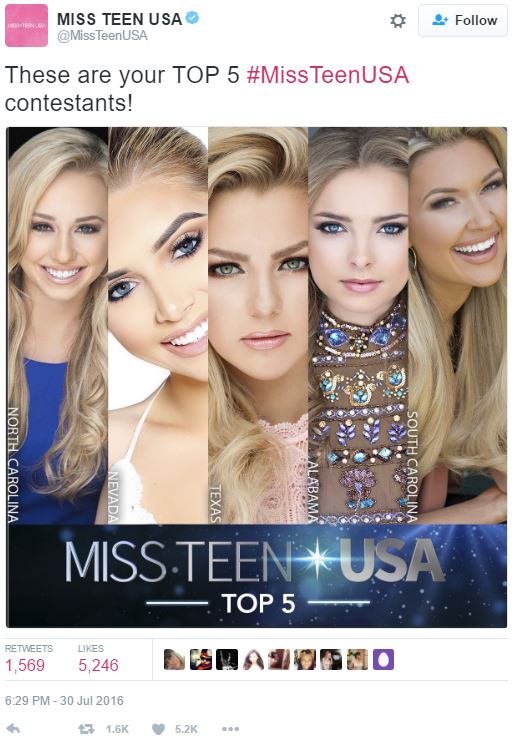
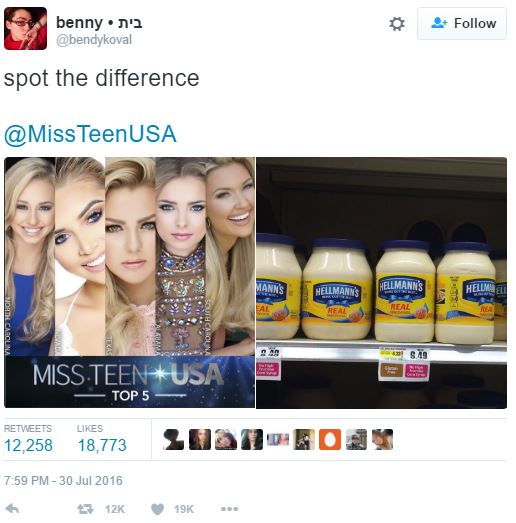
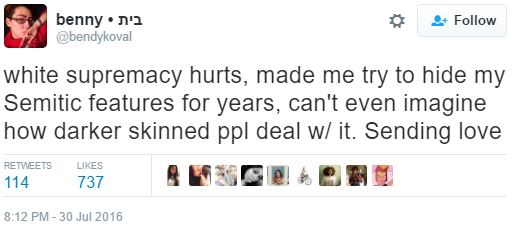
After the pageant’s Twitter account published a photo of the five finalists in the July 30 contest, Koval responded by comparing the contestants — all blue-eyed blondes — to so many identical jars of mayonnaise.
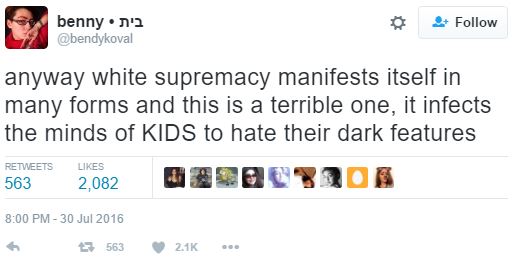
This bit of sarcasm got more than 12,000 retweets and 18,000 likes on Twitter, but then Koval issued a series of Tweets asserting in apparent seriousness that beauty pageants promote “white supremacy.”
Feminists have always been anti-beauty. The first protest of the Women’s Liberation movement was against the 1968 Miss America pageant, an event they said served “to further make women oppressed and men oppressors; to enslave us all the more in high-heeled, low-status roles.” Pageant contestants “epitomize the roles we are all forced to play as women,” feminists claimed, because women are “forced daily to compete for male approval, enslaved by ludicrous ‘beauty’ standards.”
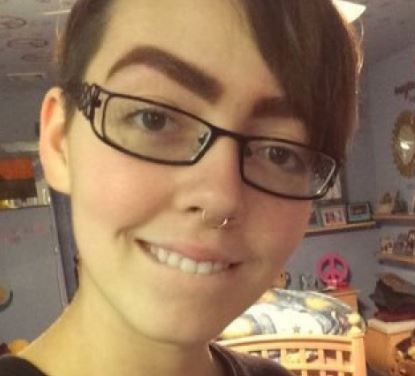
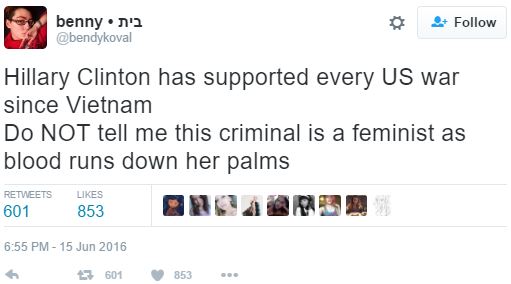
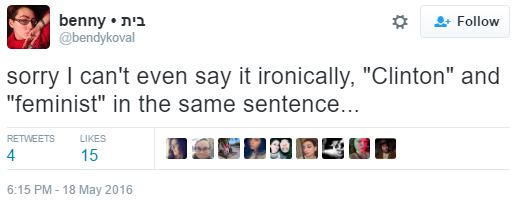
Bethany Koval hates Hillary Clinton, condemning the Democrat as a warmonger with blood on her hands who is not a feminist.
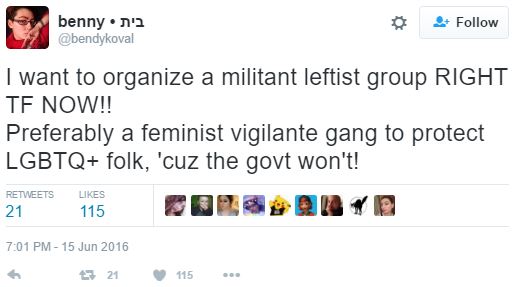
In June, after a Muslim man attacked a gay nightclub in Orlando, Bethany Koval called for the formation of feminist vigilante groups.
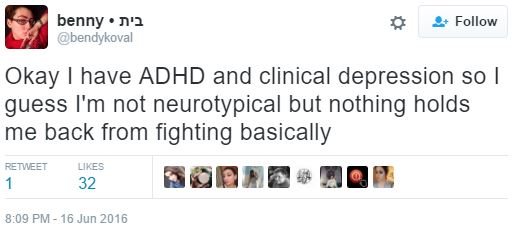
Radical teenager with clinical depression who hates Israel and Hillary Clinton, calling for “militant” action? Nothing to worry about, I guess.
CW, guns? Loud sounds?
Start training to join our cool feminist vigilante gang! Older video of me for inspiration: pic.twitter.com/iXqmnXiGgK