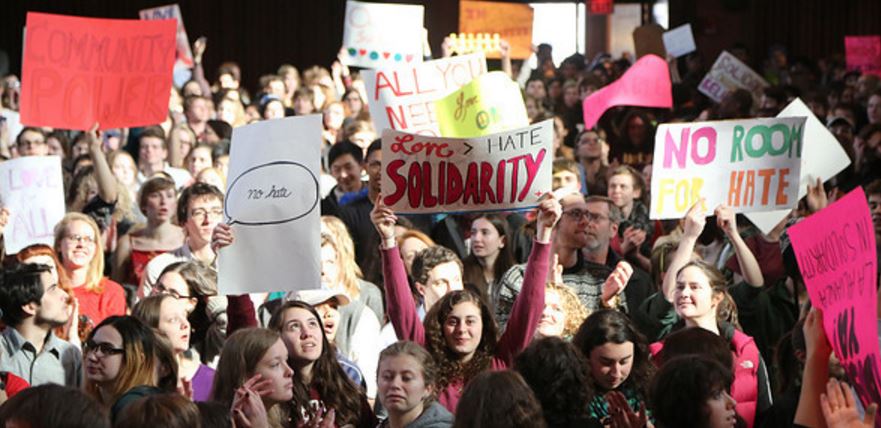
In March 2013, Oberlin College students staged a “Day of Solidarity” protest against “hate” at their elite private liberal arts school, where annual tuition is $50,586. The alleged incidents of “hate” that had prompted this protest were eventually exposed as a hoax, perpetrated by campus leftists, which was neither the first nor the last time Oberlin worked itself into a frenzy over a phony “hate” hoax. Oberlin is arguably the worst college in America — worse even than such Ivy League sewers as Yale, Harvard, Brown and Columbia — where foolish parents send their foolish children to be tutored in folly by professional fools.
It is impossible to exaggerate just how awful “elite” education in America has become, and difficult to explain why it is so bad. 
 William F. Buckley Jr.first described the degenerate tendencies of modern elite education in his 1951 classic God and Man at Yale. As I have summarized the book’s core insight, “Buckley saw that Yale, originally founded as a Christian school, had quietly abandoned Christianity and adopted a new religion, liberalism.” The outlines of this problem were clearly apparent to Buckley at Yale while Harry Truman was still president, yet academia did nothing to halt the decay of moral and intellectual standards, so that when university campuses erupted in riots in the 1960s — young radicals terrorizing their liberal elders — conservatives could say, “We told you so.” Liberals can never admit they’re wrong, so the lessons that should have been learned from the ’60s were ignored, and meanwhile the radicals were burrowing into the academic bureaucracy. Beginning in the 1990s, a series of purges swept through higher education. The humanities and social sciences were eviscerated and corrupted by the proponents of “critical theory.” If any student wished to learn anything about history without a Marxist filter, he had to do so by reading old books, as all the recent “scholarship” was devoted to reinterpreting the past through a prism of race/class/gender.
Meanwhile, in the name of “multiculturalism,” the curriculum was restructured, admissions criteria were altered and hiring policies were systematically biased in order to create a statistically acceptable representation of “diversity” on elite campuses. We should note, by the way, that the pursuit of “diversity” in admissions was never difficult at community colleges or second-tier state universities. It was only at the top-tier state schools (e.g., the University of Michigan and the University of California-Berkeley) and at highly selective private schools (e.g., the Ivy League) that admissions quotas became controversial. Many in academia accepted and promoted the idea that all ethnic groups had a “right” to be proportionately represented in the student body (and on the faculty) of universities, so that “underrepresentation” was considered proof of discrimination and social injustice. Equality of opportunity was not enough, equality of outcomes was demanded, and this egalitarian mission required the destruction of moral and intellectual standards in academia. Higher education has become a pervasively dishonest enterprise, a corrupt racket wherein parents, students and taxpayers are systematically swindled in order to provide lucrative employment for administrators and faculty whose income is dependent upon the illusion of “prestige” surrounding such schools as Oberlin College.
How bad is it at Oberlin? Nathan Heller of the New Yorker risked a visit to the lunatic campus and here are a few excerpts from his article:
On February 25th, TheTower.org published an article that included screenshots from the Facebook feed of Joy Karega, an assistant professor of rhetoric and composition at Oberlin. The posts suggested, among other things, that Zionists had been involved in the 9/11 plot, that isis was a puppet of Mossad and the C.I.A., and that the Rothschild family owned “your news, the media, your oil, and your government.” The posts did not sit well with everyone at Oberlin, where, weeks earlier, a group of alumni and students had written the president with worries about anti-Semitism on campus; the board of trustees denounced Karega’s Facebook activities. As a teacher, however, she’d been beloved by many students and considered an important faculty advocate for the school’s black undergraduates. The need for allyship became acute. And so, with spring approaching, students and faculty at one of America’s most progressive colleges felt pressured to make an awkward judgment: whether to ally themselves with the black community or whether to ally themselves with the offended Jews. . . .
g, at Oberlin, I tracked down Cyrus Eosphoros, the student who’d worried about the triggering effects of “Antigone.” . . . Eosphoros is a shy guy with a lambent confidence. He was a candid, stylish writer for the school newspaper and a senator in student government. That day, he wore a distressed bomber jacket and Clubmaster glasses. His hair was done in the manner of Beaver Cleaver’s, with a cool blue streak across the top. Eosphoros is a trans man. He was educated in Mexico, walks with crutches, and suffers from A.D.H.D. and bipolar disorder. (He’d lately been on suicide watch.) He has cut off contact with his mother, and he supports himself with jobs at the library and the development office. He said, “I’m kind of about as much of a diversity checklist as you can get while still technically being a white man.” . . .
If the new campus activism has a central paradigm, it is intersectionality: a theory, originating in black feminism, that sees identity-based oppression operating in crosshatching ways. Encountering sexism as a white, Ivy-educated, middle-class woman in a law office, for example, calls for different solutions than encountering sexism as a black woman working a minimum-wage job. The theory is often used to support experiential authority, because, well, who knows what it means to live at an intersection better than the person there? . . .
In the post-Foucaultian tradition, it’s thought to be impossible to isolate accepted “knowledge” from power structures, and sometimes that principle is turned backward, to link personal discomfort with larger abuses of power. “Students believe that their gender, their ethnicity, their race, whatever, gives them a sort of privileged knowledge — a community-based knowledge — that other groups don’t have,” [music Professor James] O’Leary went on. The trouble comes when their perspectives clash. . . .
Aaron Pressman, a politics and law-and-society major, told me that he has always felt free to express his opinions on campus, but has faced “a lot of social backlash.” One of his ambitions is to become a public defender, and he has studied the free-speech work of the A.C.L.U. Last year, when he noticed a broadly worded clause about flirtatious speech in Oberlin’s new sexual-harassment policy, he advocated for more precise language. (His research told him that such broad prohibitions were often used to target ethnic groups.) “A student came up to me several days later and started screaming at me, saying I’m not allowed to have this opinion, because I’m a white cisgender male,” Pressman recalled. He feels that his white maleness shouldn’t be disqualifying. “I’ve had people respond to me, ‘You could never understand—your culture has never been oppressed.’ ” Pressman laughed. “I’m, like, ‘Really? The Holocaust?’” . . .
“Oberlin does a really good job of analyzing intersectionality in the classroom — even in discussions, people are aware of who’s talking, who’s taking up space,” Kiley Petersen, a junior, told me. “But there’s a disconnect in trying to apply these frames of intersectionality and progressive change to departments and this school as a whole.” Some students have sought their own solutions. Earlier this year, a sophomore, Chloe Vassot, published an essay in the college paper urging white students like her to speak up less in class in certain circumstances. “I understand that I am not just an individual concerned only with comfort but also a part of a society that I believe will benefit from my silence,” she wrote. . . .
You can read the whole depressing thing. What’s most depressing about it is that people actually pay money to attend Oberlin. Heck, $50,586 a year is nearly a thousand bucks a week, and imagine all the fun things you could do with that kind of money. You could develop a heroin addiction, for example. A teenage junkie could spend four years shooting up and, by age 22, would probably be less confused than a typical Oberlin graduate.
Oh, sure, it’s probably a bad thing to be addicted to heroin, but you never hear a junkie babbling about “frames of intersectionality,” do you?



 One of the books I most often recommend is

 In his book

 In fact, as John Earl Haynes and Harvey Klehr explain in their 2005 book


 William F. Buckley Jr.first described the degenerate tendencies of modern elite education in his