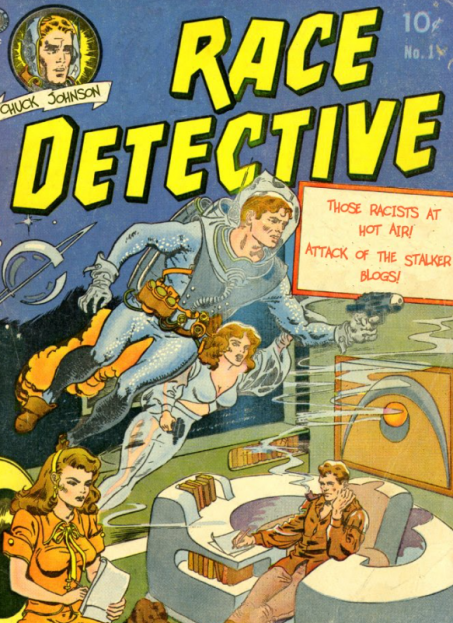
When my wife and I were stuck at the Minneapolis airport for a nine-hour layover Monday, I had to come back in through the TSA security screening every time I went out to grab a smoke, and on my final trip through the line, I noticed a teenage girl in front of me removing her shoes. This being Minnesota — a state with a large Scandinavian population — the girl was blonde and had her hair braided in such a way as to remind one of a Bund Deutscher Mädel propaganda poster.
The absurdity of the situation probably wouldn’t be noticed by most air travelers, who have long since become accustomed to the hassle of TSA screening implemented in the immediate aftermath of the 9/11 attacks. But watching this blonde girl unlacing her sneakers reminded me of what I’d written when we started our trip:
Remember the “Shoe Bomber”? In December 2001, would-be terrorist Richard Reid was aboard an American Airlines flight from Paris to Miami when he failed in an attempt to detonate plastic explosives hidden in his shoes. Because of this botched terrorist attack, all commercial airline passengers to this day are required to remove their shoes and send them through the X-ray scanners before boarding their flights.
More than 20 years have gone by, and if this safety protocol has apprehended or deterred a single copycat “shoe bomber,” I’m unaware of it, but it keeps TSA busy, on the taxpayer’s dime, inspecting us all just to make sure we aren’t some kind of Al-Qaeda sympathizer.
Everyone must remove their shoes, and everyone must empty their pockets and send their belongings through the X-ray scanners because the government can’t differentiate between who is and is not actually a terrorist risk. That would be RAAAAACIST, you see, and we can’t permit that. Therefore the Scandinavian teen with her Bund Deutscher Mädel braids must consent to be searched just the same as any Palestinian. Noticing the absurdity of this? Yeah, that’s also RAAAAACIST.
Even if you don’t pay much attention to such things, it’s easy to see why Sen. Tommy Tuberville is being targeted with a “white nationalist” smear. Ever since the 2020 exit polls showed Republicans gaining ground among Latino voters, liberals have been in a state of quiet desperation as they lay the groundwork for re-electing Mister 81 Million Votes.
It is no longer sufficient, given the circumstances, for liberals to point their fingers and scream “RAAAAACIST!”Gail Heriot has remarked:
The word “racist” got used up a few years ago. It had been used so often to apply to things that obviously weren’t racist that it lost its sting. “White supremacist” took its place, but it’s headed in the same direction.
As the “white supremacist” label gets worn out, now liberals have increasingly begun using “white nationalist,” thus taking a giant leap toward accusing people of being outright Nazis. With that in mind, take a look at these recent headlines in l’affaire de Tuberville:
There is a game being played here, you see, and whoever is advising Sen. Tuberville apparently doesn’t understand the rules of this game.
The first thing to do, when facing such an accusation, is to question the authority of the accuser: Who appointed you — Jake Tapper, or whoever — as the Grand Inquisitor of this anti-racist crusade? Where are the credentials that establish your authority to conduct this inquiry?
Liberals never anticipate such a response. They take their authority for granted, and never expect to have their bona fides called into question. This explains why everybody says, “Charles Who?” whenever I mention my 2009 blog war against Charles Johnson of Little Green Footballs.
The premise of CJ’s assault on my reputation was that I was a neo-Confederate white supremacist, whereas the premise of my defense was that Charles Johnson is a goddamned fool. Check. Mate.
To this day, I have no idea what genius was behind the comic-book parody Chuck Johnson: Race Detective, but it struck the perfect tone in mocking the absurdity of CJ pretending to be morally superior to the various conservative bloggers (including Pamela Geller) whom he accused of harboring crypto-fascist sympathies.
Having vowed not merely to survive this attack, but to destroy the attacker, I took advantage of the fact that, over the course of the preceding couple of years, CJ had been purging LGF of any commenters who disagreed with his madcap jihad against Geller & Co. There were a lot of people fed up with CJ’s bullshit, and so when I stood up to him, there was a ready-made audience cheering me on in that fight.
Nearly 15 years have gone by, during which I’ve covered politics at every level — and damned near got that ambassadorship to Vanuatu that I coveted for so long — whereas Little Green Footballs . . .
Well, “Charles Who?”
If more people understood how to respond to such attacks, we could permanently wreck the Progressive Smear Machine, and leave it in a heap of discredited scrap metal. Forget about denying the accusation, or explaining away whatever “evidence” the accuser is waving in your face. Question the premise of the accusation (i.e., the belief that there is some eminent danger from a secretive cabal of right-wing RAAAAACISTS!) and question the authority of the accuser. Why should anyone care about me (or you or Tommy Tuberville) as a suspected member of this alleged “white nationalist” conspiracy? What have I done — or what am I supposed to be planning to do — that poses such a menace to the commonweal that my allegedly malevolent intent must be “exposed”? To ask such questions is usually enough to make reasonable people pause and examine the important question of motive: What’s the point of all this “investigative journalism” stuff about accusations of racism (or “white supremacy” or “white nationalism,” etc.)?
What do these self-appointed investigators aim to achieve by “exposing” the terrible Thought Crimes of the Wrongthinkers?
Even if some people are indisputably far gone down the path of race-obsessed kookiness (e.g., Kevin DeAnna and the “Wolves of Vinland”), do we really need an army of self-appointed investigators to root around for every telltale clue of secretive “white nationalist” sentiment in order to DEMAND THAT EVERY REPUBLICAN DENOUNCE IT?
The bottom line to this whole thing is that it’s just partisan politics — “Democratic Operatives With Bylines” trying to help their bosses win another election by smearing Republicans as crypto-Nazis.
There is no actual danger — no genuine nexus between violent extremists and, for example, a senator’s objections to Pentagon policy (which is why Tuberville has been blocking military promotions, thus making himself a target of this crazy “white nationalist” attack).
If the intent of the “We Must Expose the Racists” crowd were to reduce the level of racial hostility in America, they wouldn’t be operating the way they operate, which tends to exacerbate paranoia all around. Constantly being told that a sizable proportion of white Americans harbor hateful sentiments, black people and other minorities are encouraged to hate and fear white people, and to buy into a victimhood narrative, where every problem in their lives is to be explained by “systemic racism.” Meanwhile, any white person concerned about the drift of social and political trends — e.g., the lawless anarchy in “Killadelphia” — is confronted with evidence that the media elite are actually in favor of turning the country into a nightmare dystopia of unpunished theft, open-air drug markets, drive-by shootings, etc. Every day, observant people can see headlines like “Illinois to Require Landlords Rent to Illegal Aliens” and calculate which way the winds are blowing, and if they don’t like it? Well, they’re “white nationalists,” according to the liberal media and, after a while, some people will start asking themselves, “Am I really that name they keep calling me? Maybe I should check out this ‘white nationalism’ stuff and see what it’s about.” Where might this lead?
Well if you want more Trump, this is how you get more Trump.
The more liberals keep denouncing everything and everybody as “racist,” “white supremacist,” “white nationalist,” etc., the more indifferent people will become to these accusations, and many of them may start sympathizing with genuinely dangerous people. Liberal journalism is like free advertising for the kook fringe. If CNN keeps calling your Republican senator a neo-Nazi, and you think the senator is an OK guy, well, why not just go check out some neo-Nazi threads on Reddit or whatever?
Free publicity? Yeah, I need me some of that. It sure would be nice if a liberal journalist, maybe a guy with a diploma from Harvard, were to write a hit piece this week about what a dangerous right-winger I am.
What kind of car do you drive? What are your monthly car payments? Excuse me for asking, but one fact that caught my eye in this story out of Chicago was that Arsenio Cooper was driving a Jaguar SUV. A quick Google search informed me that a used 2020 Jaguar SUV can be had for somewhere in the $30,000 to $40,000 range, causing me to wonder how Cooper was making his car payment while out on bail:
A seven-time convicted felon charged with shooting and trying to kill a long-time friend was on bail for a felony case in which he’s accused of having more than three pounds of pot in his car.
Arsenio Cooper, 33, is the 13th person accused of shooting, killing, or trying to shoot or kill someone in Chicago this year while awaiting trial for a felony. The cases involve at least 18 victims, seven of whom died.
Prosecutors said Cooper saw his friend of 15 years walking a dog in the 3200 block of West Washington around 5:45 a.m. on May 19, and they had a conversation. But Cooper grew upset and drove away in his Jaguar SUV, Assistant State’s Attorney Kathryn Morrissey said during Cooper’s bail hearing.
Cooper’s friend put his dog away, then came back out to speak with someone else. As they talked, Cooper returned in the Jaguar, got out, and opened fire on the victim, Morrissey alleged.
One round struck the 36-year-old victim in the face. He ran toward his home as Cooper ran after him, “firing round after round,” Morrissey continued. The victim saw bullets hitting the front door of his house as he ran inside. Morrissey said a Ring doorbell camera recorded it all.
Cooper returned to the Jaguar and drove away while the victim’s sister called 911.
Assistant Public Defender Catherine Fisher, representing Cooper during the bail hearing, claimed that the victim brandished a firearm and said Cooper had been advised that the victim was waiting for him with a gun. It’s a self-defense case, she argued.
Judge Ankur Srivastava held Cooper without bail on a charge of attempted first-degree murder.
(No bail? In Chicago? Do you realize how rare it is for anyone to be denied bail in Chicago, no matter how serious the crime?)
Cooper was on bail while awaiting trial for allegations that police found 1,600 grams of suspected marijuana inside three backpacks in his car during a traffic stop in March 2022, according to court records.
At the time of the traffic stop, Cooper was on bail for yet another felony case in which he faced charges of Class X armed habitual criminal and manufacture-delivery of cannabis, records show. He was acquitted of those charges in November.
Morrissey said his previous felony convictions include unlawful use of a weapon by a felon in 2019, possession of cannabis in 2015, manufacture-delivery of cannabis in 2012, unlawful use of a weapon with a previous conviction in 2011, and disarming a police officer and aggravated battery in 2007.
Given this information, what do you suppose Arsenio Cooper’s credit rating looks like? Yet somehow, this menace to society walks into the Jaguar dealership and walks out with the keys to a $40,000 SUV? Can someone please explain to me how this happens? Do I just need to move to Chicago and start committing felonies in order to qualify for Jaguar’s “SUVs for Criminals” program? Not that I mind driving my old Nissan clunker, but maybe it’s time for an upgrade. Just get myself a pistol and deal some dope, and I’ll be riding fine in a late-model Jag.
But I promise not to shoot any of my “long-time friends.”
Republican Sen. Tommy Tuberville of Alabama on Monday doubled down on his comments on White nationalism, saying it was an “opinion” that White nationalists are racist.
During an interview on CNN’s “The Source with Kaitlan Collins,” Tuberville repeatedly defended his previous comments. When Collins stated the definition of a White nationalist is someone who believes that the White race is superior to other races, Tuberville said, “Well, that’s some people’s opinion.”
When asked what his opinion was, Tuberville said, “My opinion of a White nationalist, if someone wants to call them White nationalist, to me is an American.”
Speaking on an individual level, Tuberville added, “If people think a White nationalist is a racist, I agree with that.”
Tuberville previously faced backlash regarding comments made originally in an interview with a local Alabama radio station when he was asked if he believes White nationalists should be allowed in the military and responded, “I call them Americans.”
In May, Senate Majority Leader Chuck Schumer had called on the Alabama senator to denounce White nationalism as “un-American,” and stop his hold on military nominations, CNN previously reported.
Tuberville told CNN Monday night that when lawmakers are in the minority party in the Senate, “the only power we have is to put a hold on something.”
Asked by Collins whether he knows better than seven former defense secretaries who penned a letter in May arguing the hold was “harming military readiness and risks damaging US national security,” Tuberville said: “They were nominated, they weren’t elected. I was elected to represent the people of Alabama in this country.”
MINNEAPOLIS
We’ve got a long layover before the next leg of our flight back home from Alaska, which gives me an opportunity to explain what was wrong with the lousy in-flight movie on the way here from Anchorage. What was wrong with Need for Speed (2014) can be summarized succinctly — everything. It stars Aaron Paul, whom you most likely would recognize as Jesse, the young meth addict who served as Walter White’s accomplice in the popular AMC series Breaking Bad (2008-2013).
We flew here on Big Country airline, which has updated its delivery of in-flight movies so that you log onto an internal server with your phone or other device, and then have access to a variety of entertainments. With a five-hour flight, my first choice was the three-hour-long 2001 Michael Bay-directed Pearl Harbor. I recall seeing that when it was out in theaters, but for some reason it didn’t annoy me nearly as much then as I did rewatching it on the plane. If you think that the output of Hollywood only recently began to suck because of “wokeness,” you really need to take a critical look at Pearl Harbor. But why even bother slagging that movie, when Need for Speed so much more obviously deserves slagging?
“Why is this guy the hero?” That’s the question that began to bother me more and more as the movie went on. Perhaps I didn’t pay close enough attention to the setup in the opening scenes, but the movie is about illegal street racing, so the question occurred to me, why is the criminal Tobey Marshall, played by Aaron Paul, the hero, while “Dominic Cooper as Dino Brewster: a former Indy racer and Tobey’s fierce rival” (to quote Wikipedia) is the villain? The moral distinction between the two is not obvious, except that Tobey is a blue-collar hard-luck case, whereas Dino is apparently wealthy and well-connected. Quoting Wikipedia again:
Tobey Marshall is a former race car driver who owns his late father’s garage, Marshall Performance Motors, in Mount Kisco, New York, where he and his friends tune performance cars. Struggling to make ends meet, he and his crew participate in street races after hours. After a race, Tobey’s former rival Dino Brewster conscripts them into completing the build of a rare Ford Shelby Mustang worked on by the late Carroll Shelby, in exchange for 25% of the car’s sales revenue.
Does that make any sense at all? If not, it might help to know that the movie was an “adaptation” a video game of the same name. The screenplay is the work of John Gatins (who was nominated for an Oscar in 2012) and his brother George. Exactly how this project came about, I’m not sure, but I guess the idea of a tie-in to a popular videogame was the selling point — a ready-made audience of game enthusiasts — and the plot was contrived to give some kind of dramatic text to the movie’s main action-flick appeal, i.e., lots of car-chase scenes highlighted by dramatic crashes done with CGI effects. If the plot is implausible and the character development deficient, it’s probably because the producers figured, “Who cares? We’re making a movie for an audience of socially awkward teenage loners who have nothing better to do with their lives but spend endless hours playing a stupid race-car game.” Which is to say, the filmmakers have contempt for their audience, and really, who can blame them? Anybody who would pay money to see this movie deserves all the contempt they get. Honestly, I kind of hate myself for wasting two hours watching Need for Speed, and it didn’t cost me a dime.
“Why is this guy the hero?” That question applies not only to the character Tobey Marshall in Need for Speed, but also to the actor Aaron Paul, who plays him. What made Paul so believable as Jesse in Breaking Bad was that he gave off the vibe of the kind of small-town dopehead who would get mixed up in a drug-manufacturing scheme with his former high school chemistry teacher. There wasn’t anything remotely heroic about Jesse, and if viewers found themselves rooting for him, it was only because his and Walter’s enemies — rival drug gangs, etc. — were so monstrously bad. But that vibe doesn’t work in Need for Speed, where the protagonist Tobey is supposed to be a racing driver of exceptional ability who, unfortunately, never got his shot at the big time because his father died (or whatever). Sorry, but I just can’t “buy” Aaron Paul as an extraordinary driver. He is a UCLA film-school graduate’s idea of what a blue-collar hero looks like. And dear God, how the filmmakers strive to sell this underdog-from-the-small-town angle which, by the way, is utterly implausible because Mount Kisco, N.Y., is in Westchester County, an affluent suburb of New York City. While Mount Kisco is somewhat below the county average in terms of household income, it’s not the first place you’d think of when you hear the phrase “blue-collar America.”
Guess what? The target audience didn’t care. Need for Speed grossed about $45 million in domestic release, but nearly four times as much in foreign sales, especially in China. Perhaps something about the scenery of Mount Kisco made it perfect as a foreigner’s idea of what small-town America looks like and, of course, the casting of the movie placed the white protagonist amid an appropriately multicultural crew of “buddies” — a couple of Hispanic dudes and a black guy. Scott Mescudi (who, as a rapper, is known as “Kid Cudi”) as “Sergeant Benny ‘Maverick’ Jackson: a member of Tobey’s crew, and a former National Guard soldier. He is a pilot, able to fly small aeroplanes and helicopters. . . . He owns a Cessna 182” (again, quoting Wikipedia). Would you be surprised to learn that the population of Mount Kisco is less than 1% black? Would you be surprised to learn that very few black people in America are licensed pilots, let alone own their own plane? A used Cessna 182 costs around a quarter-million dollars, and then there’s the cost of hangar rental, maintenance, fuel, etc. Being a small-plane owner is not a cheap hobby.
So the audience is not only supposed to believe that Tobey just happens to be buddies with one of the few black guys in Mount Kisco, but also that Tobey’s buddy just happens to be a statistical rarity, a black pilot with his own plane. And, you may wonder, why does this matter? Because the second act of the movie involves a high-speed cross-country journey and Tobey’s pilot buddy Benny flies as aerial reconnaissance to warn him about cops up ahead or whatever. See, the filmmakers had to find some way to make it (remotely) possible that you could actually get away with driving triple-digit speeds all the way across America in the 21st century, when technology has given law enforcement an insuperable advantage in dealing with speeders. Being an aficionado of police videos on YouTube, I can assure you that Tobey’s cross-country journey would be impossible. And dear God, he’d probably get killed if he went through Arkansas, where the state patrol does not play around.
If it were so easy to get away with driving over 100 mph — which is what the audience of Need for Speed is evidently expected to believe — why doesn’t everybody do it? Video surveillance is omnipresent in America nowadays, and even if you could outrun those high-powered Dodge Chargers that state troopers use as pursuit vehicles, video evidence would permit them eventually to apprehend and convict you of fleeing-and-eluding (a felony). That is, assuming you didn’t kill yourself in a crash, which is not an uncommon fate for such criminals.
Street racing is a crime, and the idea that people who engage in street racing are exceptionally skilled drivers — well, where does that idea come from> Evidence against such a claim isn’t hard to find (e.g., “Tampa police say teens were street racing before crash that killed 2”), and most mature adults probably suspect, as I do, that street racers usually are just show-offs with misplaced priorities. And again, I return to this question about the protagonist in Need for Speed: “Why is this guy the hero?”
If you’re the kind of awkward teenager who wastes your life playing video games, I suppose, there might be a fantasy-fulfillment aspect to Need for Speed that makes you relate to Tobey as the hero. And that’s just the problem: The fantasies of maladjusted 15-year-old boys — the cinematic expression of their frustrations, acted out in cartoonish ways — are warped and unrealistic, and are not appealing as entertainment to any intelligent and emotionally healthy person.
Here’s something to think about: Why do we like car chases in classic action movies like Bullitt and The French Connection? Because in both of those movies, the chase involves the good guy chasing the bad guys — and the good guy is a cop. We understand that the criminal, in a desperate attempt to escape justice, will drive with no regard for public safety, and that this in turn requires the police to take risks in order to catch up with the bad guy. Thus, the risk of the chase is forced upon the police protagonist — it’s not what he wants to do, but he is left with no other choice because of the criminal’s action. What makes a movie car chase compelling is conspicuously absent in Need for Speed, which celebrates fast driving for the sake of fast driving, with no regard for motive.
Consider the series of events that leads to the climax of Act One, the death of Tobey’s buddy Pete. There’s this super-valuable Shelby Mustang, recall, and here’s the relevant plot sequence via Wikipedia:
The completed Mustang is displayed for auction at a party in New York City. Tobey and Dino meet Julia Maddon, an English car broker whose client, Bill Ingram, wants to purchase the car if they can prove it will drive over 230 mph, as Tobey claims. Despite Dino’s objections, Tobey takes the Mustang to a local race track and successfully drives it at 234 mph, convincing Ingram to purchase it for $2.7 million.
Enraged by Tobey’s disobedience to his objections, Dino challenges Tobey and his friend Pete to a race after Pete flatly tells Dino that everyone knows Tobey is a better driver than him. Dino offers to relinquish his entire share of the Mustang sale if Tobey wins, otherwise Tobey will have to forfeit his share. He challenges them to race with his uncle’s three Koenigsegg Agera R cars illegally imported from Europe. On the home stretch, realizing he is about to lose the race, Dino intentionally bumps into Pete’s car, sending it down a ravine and killing Pete as it bursts into flames. Dino disappears from the scene, while Tobey is arrested by the police and sentenced to two years in prison for involuntary manslaughter, unable to prove Dino was there.
When this movie was made, the Swedish-made Koenigsegg Agera had recently been crowned “Hypercar of the Year” by Top Gear magazine. If you had an extra $1.5 million handy, and an urge to drive 275 mph, this was your car. That Dino’s uncle just happened to have three of these exotic sports cars in his garage, and that Dino decides it’s OK to “borrow” them for his ego-inspired race against Tobey and Pete — well, if that’s not your definition of “implausible,” you need a new dictionary.
Perhaps there is somewhere in America you could get away with street racing in a million-dollar European supercar, but is Westchester County, New York, one of those places? And how many rich guys have three car like that which their nephew thinks it’s OK to borrow for a race inspired by personal revenge over an insult? Anyway . . .
Upon his release on parole, Tobey sets out to avenge Pete’s death. He borrows Ingram’s Mustang to enter the De Leon, a winner-takes-all exotic car race organized by the mysterious Monarch, but as a condition, Ingram requires Julia to accompany Tobey while Tobey is driving the Mustang. The pair have 45 hours to reach San Francisco before the race starts. In Detroit, they cause an interstate chase with the Michigan State Police and upload the footage. Dino offers his rare Lamborghini Sesto Elemento to anyone who can stop Tobey entering the race, causing a group of truckers to go after the Mustang as well. Julia retaliates by convincing Monarch of Tobey’s innocence, securing his invitation to the De Leon.
This idea of the “De Leon” as a sort of international championship of illegal street racing, “organized by the mysterious Monarch” (played by Michael Keaton) is preposterous. The “winner-take-all” means that six guys driving six million-dollar exotic cars (Bugatti, Lamborghini, etc.) are each betting their cars as the stakes, so that the winner gets the cars of the other five drivers. So, yeah, you’re so rich that you can spend $2.4 million for a Bugatti Veyron and you’re also such a macho egomaniac that you’re going to risk this expensive car in a street race against five other supercars, including a hand-built Saleen S7. Grant that some people are both rich and crazy — “Hey, let’s get in a carbon-fiber mini-submarine and go see the Titanic!” — but is it likely that six of them would be racing their million-dollar supercars this way? If you’ve got that kind of money to throw around, why not just rent a racetrack for the weekend?
Or, for that matter, why not build your own racetrack?
Obviously, I’m not the first person to point out this absurdity — or the many other absurdities in Need for Speed. My point, however, isn’t just that this movie is ridiculously bad, but rather that the people who made the movie believed that many people would pay money to see something this bad — and they weren’t wrong! This stinking pile of garbage cost $66 million to make, and it grossed more than $200 million worldwide, which is a sad commentary on the human condition.
In a world full of stupid people, all kinds of terrible things happen, and the fact that this awful movie actually turned a profit is almost as terrible as Joe Biden getting 81 million votes. But yeah, that’s a different definition of “implausible,” I guess.
Marion in the hands of the bad guys – but not for long…
After her memorable debut as Katy in Animal House, Karen Allen appeared in a sizable number of movies, but people probably remember her best as Marion Ravenwood, the feisty feminine foil to Harrison Ford’s adventurous archaeologist in Raiders of the Lost Ark and its sequels, including the (apparently) regrettable Dial of Destiny. While it was tempting to go with Karen displaying her fine assets in Animal House, I decided to go with a more demure pic from Raiders of the Lost Ark instead, in the interests of keeping this blog PG-13. She still looks good, considering she’s in her seventies. Ceterum autem censeo Silicon Valley esse delendam.