Buckleyesque
Notes on a Rhetorical Method

“Philip’s perspective typifies the tautological nature of intellectual consensus . . .”
— God and Man at The American Spectator

While I was proofreading that little essay just now, Mrs. Other McCain asked me, “What are you grinning at?”

She knows me too well, and recognized the mischievous smile of a man who is up to something, and expects to get away with it.

Earlier today, I called my friend Joe Marier to seek his assistance in overcoming tip-of-the-tongue syndrome. A specific word was required, and I knew exactly what it was, except that I couldn’t quite get the synapses to connect and conjure forth le mot juste.

“Tautological!” I exclaimed, when Joe finally prompted me.

My wife heard that, too, and commented that her friend Lynne had complained about my occasional tendency to sling around fancy five-dollar-words: “She said she had to keep looking up words in the dictionary.”

Guilty as charged, ma’am. And when I’m in that mood, your dictionary should also include a glossary of phrases in French, Latin and German. Likewise, you should be prepared to Google the names of various authors cited and historical phenomena to which I allude.

Better Than the Crossword

What I’m up to, of course, is employing a mode of discourse I learned to love as a boy, when the Atlanta Journal would arrive at our home and I’d apply myself to the task of comprehending the latest column by William F. Buckley, Jr.

For a boy of 10 or 11, reading Buckley was a puzzle more challenging than the crossword or the Daily Jumble. Buckley had a way of casually throwing out some brobdingnagian word, invoking the name of an ancient philosopher or referencing a battle in a once-famous war. He performed these rhetorical feats in such a confident manner that any intelligent reader felt compelled either (a) to look it up, or else (b) to abandon any pretension to literacy.

So it was that as a boy I’d find myself spending the afternoon in our living room in Lithia Springs, Ga., thumbing through the two-volume Thorndike-Barnhart dictionary and the World Book Encyclopedia in quest of the answer to that persistent question: What the hell is Buckley trying to say here?

Sure, you could infer his meaning from the context, or skip that fancy word and concentrate on the political point he was trying to convey. But anyone who genuinely desired to be educated would be so confounded by Buckley’s high-falutin allusion — e.g., “As Napoleon remarked to Marshal Soult at Austerlitz . . .” — that the resulting mixture of shame and curiosity would obligate him to look it up.

Was this Buckley’s purpose? Was he a journalistic schoolmaster or, perhaps, a smug intellectual show-off?

No, not at all. Rather, Buckley was demonstrating to the arrogant intellectual elite, and to anyone who observed his combat with them, that liberals did not possess a monopoly on erudition.

Forensic Genius, Q.E.D.

By the time I was a schoolboy driven into the bookish embrace of Messrs. Thorndike and Barnhart by Buckley’s discursive method, he had been up to something for two decades. And I imagine Mrs. Buckley sometimes noticed him grinning mischievously while he proofed his copy.

Ever since the 1951 publication of his great bombshell, God and Man at Yale, Buckley had exasperated liberals by undermining the strongest bulwark of their mid-century dominance, namely their intellectual prestige.

By the middle of the 20th century, liberals had become accustomed to winning arguments because they had all the great professors and pundits on their side. With a few rare and brilliant exceptions like H.L. Mencken and G.K. Chesterton, critics of liberalism tended to bluster reflexively about God, Mom and the American Way of Life.

To which the liberals would respond, “See there? He’s just a bigot, as all conservatives are. Quod erat demonstrandum.”

Buckley was able to turn the tables in part because of his wide-ranging knowledge, extensive vocabulary and eloquence. He did not argue like a jingo or a woolhat. His rhetoric was refined and his arguments were well-informed, so that the reasonable observer of his combat with liberalism could never say that Buckley was intellectually outgunned. Even if you disagreed with Buckley, you could not dismiss him as ignorant.

Yet Buckley was more than merely eloquent. He was a genius of forensic strategy who confounded his opponents by maneuvers that his opponents could never anticipate. 

Like Stonewall Jackson stealing a march on the Yankees in the Shenandoah Valley campaign of ’62, Buckley siezed the initiative and exploited every advantage he could gain by the element of surprise. Locating in his adversary’s argument some logical fallacy or factual error, he would suddenly come down upon the opponent’s weak point with overwhelming force, so that the opponent was obliged to attempt a defense of the erroneous premise or fallacious syllogism.

Knowing that he had his foe on the defensive, however, Buckley would bear down with bulldog tenacity until the opponent was forced either to yield that particular point or else look like a fool.

Monkey see, monkey do. My feeble emulation of Buckleyism is nothing innovative, but even this pale shadow of the great man’s art often has a similar effect, inspiring others to join in the chorus proclaiming that the liberal emperor has no clothes.

Saturday I employed Robert Knight’s column as an occasion to fire a couple of salvos at the arguments for overturning “Don’t Ask, Don’t Tell,” including a good jab at my young friend Philip Klein. Klein responded Monday and today, our fellow American Spectator contributor John Guardiano piled on.

Shortly thereafter I expanded on my earlier theme in “God and Man at The American Spectator: Intellectuals vs. Ordinary Americans,” which was why my wife caught me smiling. See if you can figure out why.

UPDATE: Via e-mail, Joe Marier informs me that Duck Hollow University — “Where Learning Is the Aim of Education” — offers a thorough, complete and comprehensive course in the science of tautology.

Mistress, Actress, Heroine

by Smitty (via Insty)

Amidst an excellent review of Nikki Haley’s campaign to govern South Carolina, Walter Shapiro says, emphasis mine:

Haley, in her first statewide campaign, has proven a master of boomerang politics – making every attack seem like a vindication of her conservative populist outrage.

Shouldn’t that be “a mistress”?

I don’t mean to go all Little Miss Attila on the point, but should conservatives worry about conserving gender in the English language? I see a page like Female Actor Search and wonder: is this an epic fail, or an admission that the language, like the Constitution and history, are poorly taught these days?

But that’s just a tangent. The poll is open, and it’s time to go participate in the primary. Go, USA!

News, Weak

The bidding for Newsweek hasn’t been exactly eager:

[S]ome Newsweek staffers . . . describe the mood as ranging from stunned to funereal to angry — the latter emotion fueled by a sense that Editor Jon Meacham erred badly by transforming the newsweekly into an upscale, left-leaning opinion magazine. Meacham has said that in the face of mounting losses — $44 million since 2007 — he had no choice but to seek fewer subscribers who would be willing to pay more.
On one level, the situation is a paradox. Here you have a magazine loaded with talent . . . and few seem willing to bet on its financial future. That amounts to a no-confidence vote not just on the category of newsweeklies, which have long been squeezed between daily papers and in-depth monthlies, but on print journalism itself. The lucrative properties these days are digital, and Newsweek’s Web site has long been a flop, both creatively and commercially. . . .
The result is a conventional wisdom, to use a phrase popularized by Newsweek, that the magazine smells like a loser.

Brilliant — losing $44 million to produce a liberal opinion magazine. Because, according to Meacham’s theory, people would pay more for liberal opinions than for news.

It takes a special kind of stupid to think that way — if you can call that “thinking.”

When A Man Claims To Be ‘Sooooo Over Woman X‘, He Is Really A Beta Male Going On Gamma

by Smitty

Dan Riehl is looking even more hapless than the TrogloPundit.
Look at the forced bravado on display:

I draw the line of hotness around sammiches. I mean, she does say she’d bring them if asked. But truly hot wimmens intuit such things.

‘Lines of hotness’? ‘Sammiches’?

Also, he says he’s so hot as to make tongues wag.  The species joke is left as an exercise for the reader.

Watching the testosterone drain out of a once great blogger like Dan Riehl is just a shame, a shame’s shame, and a reference shame for the calibration of shame-measurement equipment.
Expect Dan to be hired by Newsweek any day now.

Obamanomics: Still Not Working

The Dow Jones Industrial Average lost another 115 points Monday, after losing 324 points on Friday, for a two-day loss of 439 points (4.3%) — and a cumulative loss of 1,389 points (12.4%) since April 26. In short, if your 401(k) is mainly in stocks, you’ve lost about 1/8th of that money in about six weeks. The net gain of the typical stock portfolio since November? A big, fat zero:

Stocks slumped Monday, with the Dow and S&P 500 ending at 7-month lows, after the euro hit a fresh four-year low, adding to worries about the global economy.
The Dow Jones industrial average (INDU) lost 115 points, or 1.2%, closing at the lowest point since Nov. 4.
The S&P 500 index (SPX) lost 14 points, or 1.4%, and closed at its lowest point since Nov. 4. . . .
“Last Friday’s jobs report inspired very little confidence in terms of the economic recovery,” said Erick Maronak, senior portfolio manager at Victory Capital Management. “Add to that the anxiety about Europe and investors are very skittish.” . . .
Worries that the United States could be in danger of falling into a so-called double-dip recession have plagued markets for the last month, sending the major stock indexes down more than 10% each.

Wait, did somebody say the magic words?

Neil McKinnon of VTB Capital said: “Eurozone debt and banking problems remain paramount.”
He said worries about a “double-dip” recession were rising. “Are we moving from a V to the downleg of the W?” he asked.

Let me remind you once more what I wrote on June 1:

“What investors must wonder is whether the past month’s declining trend on Wall Street is merely a short-term correction . . . or the onset of the second wave in a W-shaped (‘double dip’) recession.”

But this was predictable long much earlier, as I reported March 4:

The United States is currently suffering from “a capital-starved economy,” syndicated columnist Donald Lambro told George Washington University students Wednesday. “We’re in for a very long period of very high unemployment.”
Noting several forecasts of “anemic” economic growth in coming years, Lambro called President Obama’s deficit spending agenda “unsustainable.”
“Government stimulus programs have never worked and they’re not going to work now,”
Lambro said . . .

And guess what? It’s going to get even worse next year:

On or about Jan. 1, 2011, federal, state and local tax rates are scheduled to rise quite sharply. President George W. Bush’s tax cuts expire on that date . . .
When we pass the tax boundary of Jan. 1, 2011, my best guess is that the train goes off the tracks and we get our worst nightmare of a severe “double dip” recession.

That’s from Art Laffer. Maybe you’ve heard of him. And maybe you’ve also heard of liberal idiots like Matthew Yglesias, who think that more Keynesian “stimulus” deficit spending is the answer. On Oct. 8, 2008, Yglesias was mocking some guy who told people to invest in gold. What if you’d ignored Yglesias and taken that other guy’s advice?

Gold rallied to within inches of its U.S.-dollar record and beat its all-time high in euros Monday as investors increasingly buy the metal as a hedge against financial deterioration in the euro-zone.
Most-actively traded gold, for August delivery, rose $23.10, or 1.9%, to settle at $1,240.80 an ounce on the Comex division of the New York Mercantile Exchange. That just missed the $1,243.10 record close for a most-active contract set in mid-May. Nearby futures had their largest one-day dollar and percentage gain since Feb. 16. . . .
“The global tensions are at a pinnacle,” said Mike Daly, gold specialist at PFGBest in Chicago. “People are saying, ‘We don’t have any confidence in these fiat currencies, and we need to move our money into tangible, safer assets.'”

Let’s just compare and contrast, shall we?

Who was that guy saying you should buy gold? Glenn Beck. Maybe you’ve heard of him.

Stimulus We Can Support: Paying The Piper

by Smitty

Although Stacy and I are still Waiting for O-Dough, an alternate revenue stream may become available, as reported by CNSNews:
Forget the astronomical joke bill, and focus on the bottom line.
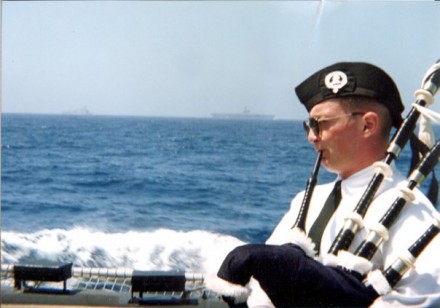
I’ve been a piper for nearly twenty years:

Flight deck of USS McClusky (FFG 41), St. Patrick's Day, 1996, somewhere off the coast of Taiwan. USS Independence (CV 62) on the horizon. The blob to the left is an oiler, but I can't recall her name.

Right now I’m working to get my pudgy body back into shape and also learning how to use my Ubuntu Studio distribution, and goodies like Kino, to edit some YouTube clips.
So hit the tip jar, follow the links, and keep up the encouragement, readers!

Helen Thomas Retires

Dateline, Treblinka:

Veteran White House reporter Helen Thomas announced Monday that she is retiring, effective immediately, in the wake of a controversy over her comments on Israel, according to a report from her employer, Hearst News Service.
Thomas told a rabbi at a White House event last week that Jews should “get the hell out of Palestine” and go back to Germany and Poland.

(Via Memeorandum.) Rumors that Ms. Thomas plans to spend her retirement in Gaza serving as a “comfort woman” for Hamas terrorists could not be immediately confirmed.

Meanwhile, Reason magazine editor Matt Welch — who is not a stupid dopehead — notes that Helen Thomas certainly isn’t the only “objective” reporter who has opinions:

[S]ome of the most politically opinionated people you’ll ever meet are newspaper reporters a couple drinks in out yakking with their colleagues. . . .
[T]he partisanship-averse journos haven’t bothered to construct their own self-conscious political philosophy, beyond identifying Bad Guys and wanting to Fix Problems. Show me the world’s most intractable problems — the Israeli-Palestinian conflict, the inability to produce mass amounts of energy without negatively impacting the environment, the search for a beer that tastes great and is less filling — and I’ll show you reporters in bars having conversations worthy of the Alex Jones show. It’s not that they’re all Helen Thomases — she is truly one of a kind — but that in the absence of subjecting their own beliefs to journalistic rigor, they are more likely than many would expect to quietly nurture beliefs that outsiders would find surprisingly slanted and even extreme.

You should read the whole thing.