A member of the cultlike group known as Zizians has been charged with murder in the [2022] shooting of her parents at their Pennsylvania home on her 30th birthday, and a prosecutor said Wednesday that authorities don’t believe she was acting alone.
Michelle Zajko, who has been jailed in Maryland on other charges since February 2025, has been charged with murder, burglary and conspiracy charges in the deaths of Rita and Richard Zajko, Delaware County District Attorney Tanner Rouse said at a news conference. The prosecutor said she did not act alone.
Rouse said that Zajko is known to have been among those who killed her parents “to the extent that if she wasn’t the one who actually pulled the trigger, she was certainly aligned with those who did.”
Online court records didn’t immediately indicate whether Zajko had an attorney in the Pennsylvania case as of Wednesday. An attorney representing her in Maryland did not immediately respond to a message seeking comment, and the Delaware County Public Defender’s office declined to comment.
The couple was shot to death in their home on New Year’s Eve after police say a neighbor’s doorbell camera captured video of a car pulling up to their home in Chester Heights, a voice shouting “Mom!” and another voice exclaiming, “Oh my God! Oh, God, God!”
Michelle Zajko has denied any involvement, and in court filings suggested her father might have killed her mother and then himself.
“I didn’t murder my parents,” she wrote in an April 2025 “ Open Letter to the World.”
Authorities, however, had long described Zajko as a person of interest in the double homicide, two of the six deaths linked to a group of young, highly intelligent computer scientists who appear to share radical beliefs about veganism, animal rights, gender identity and artificial intelligence.
Murder victims Richard and Rita Zajko.
My suspicion is that authorities traced the bullets that killed Zajko’s parents to one of the guns that she is known to have purchased for her Zizian comrades. None of those currently in custody, including cult leader Jack “Ziz” LaSota and Teresa Youngblut, have cooperated with authorities, and if prosecutors have enough evidence to convict Zajko, she’ll likely continue denying her guilt even after she goes to prison while her accomplices go free. Play stupid games, win stupid prizes.
The 1979 psychological thriller When a Stranger Calls is a cult classic, famous for one line: “The call is coming from inside the house.”
That line came to mind Tuesday night after I learned about an interesting controversy on BlueSky, the left-wing echo chamber where many Trump-haters fled after Elon Musk bought Twitter in 2022. A Canadian feminist, Phoebe Maltz Bovy, recently published a book The Last Straight Woman: On Desiring Men. A website published a 23-paragraph excerpt of Ms. Maltz Bovy’s book and, when this excerpt was promoted on BlueSky, the book’s theme and its author were angrily denounced.
Of course, I immediately ordered the book from Amazon. Anything that sends the BlueSky crowd into paroxysms of apoplectic rage must be good. After skimming through the excerpt of The Last Straight Woman, however, I quickly located the nexus of Ms. Maltz Bovy’s problem, specifically in the sentence when she declares “we need to be looking for feminist approaches to female heterosexuality.”
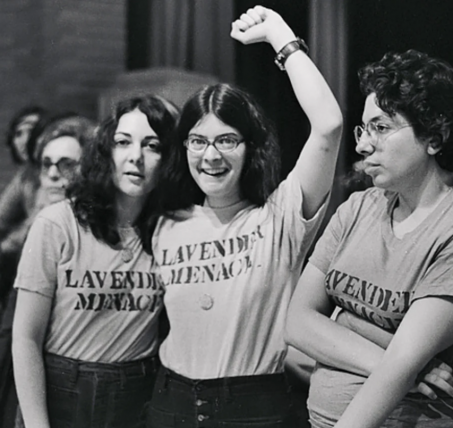
“Sex Trouble: Radical Feminism and the Long Shadow of the ‘Lavender Menace’,” first posted here in July 2014, became the first chapter of my 2016 book Sex Trouble. What most people don’t understand about feminism is that, almost from the very beginning of the so-called “Women’s Liberation Movement” in the late 1960s, lesbians were influential in the movement’s policies and rhetoric. Lesbians were involved in the creation of the first Women’s Studies programs at colleges and universities, and the curriculum in such programs has always reflected the anti-male/anti-heterosexual bias of the lesbian faculty.
Anyone who cares to research the biography of Charlotte Bunch can understand this. Prior to becoming involved in the feminist movement, Bunch had a husband, but in 1971 she got divorced, came out as a lesbian and founded a radical commune/cult called The Furies. From there, Bunch went on to become a professor at Rutgers University and an adviser to Hillary Clinton. The incompatibility of heterosexuality with women’s liberation was the essence of Bunch’s feminist ideology:
Bunch’s 1972 manifesto, “Lesbians in Revolt” essentially declared universal lesbianism as the end goal of feminism:
Lesbianism is a threat to the ideological, political, personal, and economic basis of male supremacy. The Lesbian threatens the ideology of male supremacy by destroying the lie about female inferiority, weakness, passivity, and by denying women’s “innate” need for men. …
Our rejection of heterosexual sex challenges male domination in its most individual and common form. We offer all women something better than submission to personal oppression. We offer the beginning of the end of collective and individual male supremacy.
This argument was expanded . . . by Margaret Small in “Lesbians and the Class Position of Women,” which was cited in such later books as Separatism and Women’s Community by Dana Shugar and The Invention of Heterosexuality by Jonathan Katz. In 2015, while researching my own book, I summarized Margaret Small’s argument:
[Small] offered a Marxist interpretation of “lesbian consciousness” as part of a “revolutionary struggle” to end women’s “oppression” in the “relationship of slavery,” as she called marriage. …
Invoking the historical theories of Friedrich Engels (colleague of Karl Marx and co-author of the 1848 “Communist Manifesto”), Small declared: “Class society arose because of the oppression of women. . . . The exploitation of all women by all men made possible the exploitation of some men by other men. The more exploitative the relationship between men and women becomes, the stronger and more vital become the institutions of male supremacy.” …
“In terms of the oppression of women, heterosexuality is the ideology of male supremacy,” Small wrote. “In order for men to have a justification for exploiting women and an ability to enforce that exploitation, heterosexuality has to become, not merely an act in relation to impregnation, but the dominant ideology.”
Under male supremacy, Small asserted, women “become defined as appendages to men” in a system “which maintains the ideological power of men over women.”
Marriage is slavery, “heterosexuality is the ideology of male supremacy,” and if you don’t believe that, can you really call yourself a feminist? . . .
Like most red-blooded Americans, I could care less about soccer. That having been said, I am enjoying the hell out of the tweets and other social media posts by Euros and other foreigners visiting parts of America outside the blue urban shitholes and discovering Buc-ee’s, Waffle House, barbecue, local diners, Bass Pro Shops, and other wild delights found only in the fruited plains of Red America. They’re having their minds blown by ranch dressing, free refills, and air conditioning, and it’s fun to watch.
Today’s appetizer is some fan art of Shouko Komi and her “forever 17!” mom Shuuko* from the last World Cup. Ceterum autem censeo Silicon Valley et Hamas delendam sunt.
One thing about the passage of time is that, as you grow older, you begin to notice the shift of values. What was once widely accepted — the expected social norms of your childhood — come to be viewed as quaint, old-fashioned or perhaps even barbaric. When I was born in Atlanta in 1959, Dwight Eisenhower was still president, and the South was still governed by Jim Crow segregation. By the time I started first grade in 1965, the passage of the Civil Rights Act had eliminated segregation, although of course, the customs and attitudes of the Jim Crow era did not magically evaporate overnight. Because I was just a schoolboy at the time, the politics of all this was completely over my head. My parents’ generation, being raised with a stoic temperament and a concern for civility and courtesy, didn’t talk in front of the children about the various social upheavals of the 1960s, so I really can’t say with much certainty what their attitudes were. They were staunch Democrats (as everyone was in that time and place), and reasonably liberal as such things were reckoned in that era, but I don’t know much more about their beliefs.
By the 1990s, when I was married with a family of my own, and was viewing politics through adult eyes, the message of conservative Republicans had a lot to do with traditional family values.
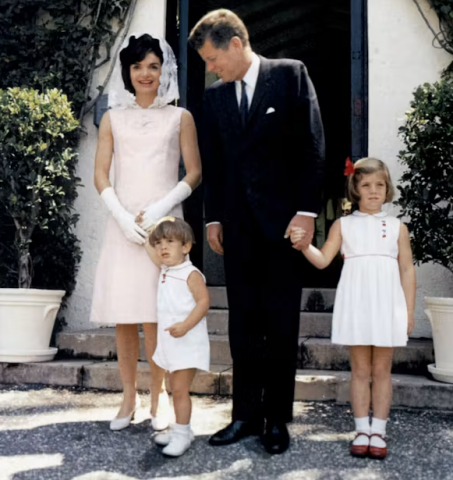
John F. Kennedy and family, circa 1960.
How was it that what had been taken for granted in America just three decades earlier had become a right-wing political agenda? The standard answer is “the Sixties,” a reference to the multitudinous changes that destabilized our national culture during that tumultuous decade.
When I was a boy growing up in Douglas County, Georgia, practically all of the kids came from “traditional families.” Divorce was considered scandalous in my parents’ generation, and none of my childhood acquaintances were from “broken homes,” to use a quaint term. Whatever other problems we had, at least most kids in my generation didn’t have to deal with the confusing welter of household arrangements — stepfathers, stepmothers, stepbrothers, half-brothers, etc. — that had become so commonplace two or three decades later. No-fault divorce was one part of the problem, but by the 1990s, America also had a rapidly growing number of bastards, to use a word now considered taboo.
Some of y’all may be old enough to remember when Hillary Clinton’s 1996 book It Takes a Village was in the headlines, criticized for what it really represented, i.e., an argument for expanding government bureaucracy as a substitute for functional families. Living inside a cocoon of like-minded liberals, it is likely that Hillary Clinton never bothered to read the most important social policy book of the 1980s, Charles Murray’s Losing Ground. What Murray demonstrated was that the social welfare programs created (or vastly expanded) in the 1960s (LBJ’s “Great Society” agenda, the so-called “War on Poverty”) had actually harmed the poor people that liberals said they meant to help, by incentivizing behaviors that increased poverty, while discouraging behaviors that could lead to a better life. Contrary to what Hillary and other liberals believed, the best thing to do for poor people was to stop “helping” them this way — cut the welfare budget and eliminate the programs.
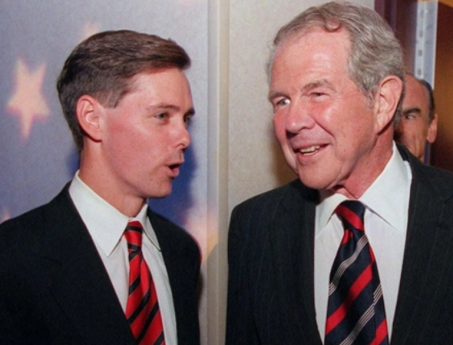
Ralph Reed (left) and Pat Robertson (right) in 1997
The arguments made by Charles Murray in Losing Ground were aimed at policy wonks, but the way the “family values” agenda entered the mainstream of Republican Party politics was via a popular TV preacher, Pat Robertson. Beginning in 1966, Robertson began co-hosting a weekday TV show, The 700 Club, which I remember my Grandma Kirby watching regularly in the 1970s. The 700 Club became the foundation of Robertson’s cable-TV channel, the Christian Broadcasting Network (CBN), which launched in 1977. Robertson had a large nationwide following by the time he announced his candidacy for the 1988 Republican presidential nomination. Even though he stood no chance against George H.W. Bush, the incumbent vice president, Robertson made a fairly respectable showing, collecting 115 delegates and more than a million votes during the primaries. Along the way, Robertson also developed a core group of grassroots volunteers (particularly in Iowa) and, most importantly, a mailing list of campaign donors.
The donor list from the Robertson 1988 campaign became the financial basis of the Christian Coalition, which in 1989 hired young Republican operative Ralph Reed to be its executive director. Reed’s success as a political organizer and strategist was crucial to the Republican takeover of Congress in 1994. While the lion’s share of credit for that belongs to Newt Gingrich — who himself praised the role of Rush Limbaugh in the 1994 campaign — a lot of the conservative “foot soldiers” who made that campaign a success were part of the army of activists that Ralph Reed had helped recruit and train. Thus you have a very condensed explanation for how “traditional family values” came to be seen as a right-wing agenda.
Most of what people think of in this context is opposition to (a) abortion and (b) “gay rights.” This is a very narrow and negative understanding of what has motivated Christian conservatives since the 1990s, namely, a desire to maintain (or restore) the middle-class married household as the defining institution of American life. As Charles Murray showed in Losing Ground, it was the decline of married-family households (or, viewed from the opposite end, the increase of children growing up in non-traditional households) that was largely responsible for a lot of other things that had gone wrong in America by the mid-1980s.
If there were any one thing I would like to stress in discussion of Christian conservatives and the so-called “Culture Wars,” it would be this: We cannot vote our way into heaven, nor can mere politics restore America’s “traditional family values.” Now let me tell you a story.
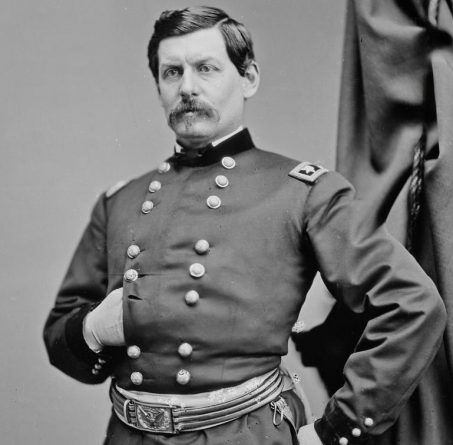
Gen. George B. McClellan
‘But You Must Act’
When he was first appointed to command the Union army defending the nation’s capital after the Yankees were defeated at Bull Run in July 1861, George McClellan was hailed as a heroic figure, destined for greatness. He set about training and equipping the rabble of raw recruits streaming into Washington, D.C., and began formulating a bold plan. Rather than marching out to fight the Rebels camped near the old Bull Run battlefield, McClellan instead would mount a massive amphibious project, transferring his army to the Virginia peninsula between the James and York rivers, thus to attack the Confederate capital of Richmond from the east. This would reverse the strategic picture; instead of the Union army being forced to defend the capital in D.C., instead the Souterners would be compelled to defend their own capital. The theater of war would be transferred from Abe Lincoln’s doorstep to Jefferson Davis’s backyard, so to speak. Lincoln approved this plan, but in consideration of concerns from Cabinet members and congressional leaders, stipulated that McClellan must leave behind in the vicinity of Washington enough troops to make sure that the Rebels didn’t make a leap at the capital while McClellan was busy shipping his army down to the Virginia peninsula. McClellan agreed to this, and as part of his arrangements, decided to transfer some troops that were then stationed in the Shenandoah Valley eastward to become part of the force defending the capital. With this problem taken care of, McClellan and his army of more than 100,000 men set sail from the wharves of Alexandria on March 17. The army disembarked at Fort Monroe, on the tip of the peninsula, and began moving inland, when disaster struck more than 200 miles away — disaster in the form of Thomas “Stonewall” Jackson.
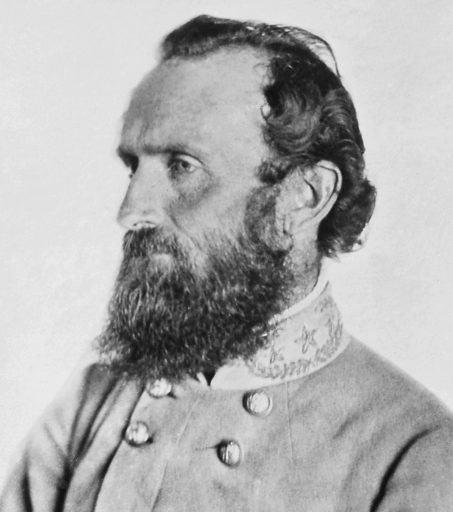
Confederate Gen. Thomas J. ‘Stonewall’ Jackson
Jackson commanded barely 4,000 troops in the Shenandoah Valley, and when he discovered that part of the Yankee army opposing him was being withdrawn, he resolved to attack the remainder immediately. It turned out that Jackson had underestimated the Union force that had been left in the Valley, and he suffered a bloody repulse when he attacked them at Kernstown on March 23. Despite this, however, Jackson’s aggression had a major strategic impact. Lincoln and others in Washington could not believe that Jackson had attacked with such a small force, and figured he must have at least 10,000 men in the Valley. McClellan being all the way down at Fort Monroe, Lincoln and his advisors set about to counter this perceived threat and, in the process, took a hard look at the actual number of troops that McClellan had left to guard Washington. What they found struck them as completely inadequate to the task — the capital seemed very vulnerable, and there was fear that Jackson’s attack at Kernstown might herald a Confederate offensive — which led Lincoln to withdraw from McClellan’s command an entire army corps, so as to make sure that D.C. was safe. Public criticism of McClellan’s slow progress in his Peninsula campaign was widely heard in the capital, as Bruce Catton narrates in Mr. Lincoln’s Army:
The clamour against McClellan deepened, became a clamour against Lincoln for keeping him in command. Lincoln tried to give McClellan an understanding of this increasing pressure as a factor which McClellan would have to keep constantly in mind when he made his plans; tried to show him that it was a pressure which, political conditions being what they so regrettably were, even the President of the United States might finally be unable to resist. On April 9, Lincoln wrote him: “And once more let me tell you, it is indispensable to you that you strike a blow. I am powerless to help this.” He concluded the letter by assuring McClellan that he would sustain him as far as he could: “but,” he added, “you must act.”
“You must act” — that is the essence of the message I would share with young people on this Father’s Day. However much anyone might hope to accomplish through politics, in terms of preserving “traditional family values” in America, what matters more is what we actually do in our everyday lives. Many millions of dollars in campaign contributions have been spent, and untold hours of labor by activists has been done in terms of electing candidates and promoting legislation that might advance a conservative agenda. What have I done? Well, I’ve stayed married to the same woman for 37 years, sired and raised six children to adulthood, and occasionally do what I can to help with the grandkids.
What I have done is to live “traditional values,” rather than merely to talk about them, or to vote for them. Once upon a time, living this way wasn’t considered political at all. People fell in love, got married, had kids, etc., and because almost everybody was living that way, there wasn’t anything controversial about it. Nowadays, however, to live that kind of life — husband and wife, mom and dad, “till death do us part” — makes you some kind of right-wing extremist. The SPLC might even put you on their “Hate Map” for suggesting that this is the best way to live.
Be an extremist, and have fun doing it. Certainly, I’ve had a blast.
Happy Father’s Day to all you right-wing extremists everywhere!
Most of the managers have their keepers in, which means I can scroll through the free agent list and start wondering if any of the desirable players are going to last until the 9th round when I pick. We have four openings in Pete’s league, so if you wanted to scratch that general manager/field manager itch, now’s your chance. Ceterum autem censeo Silicon Valley et Hamas delendam sunt.