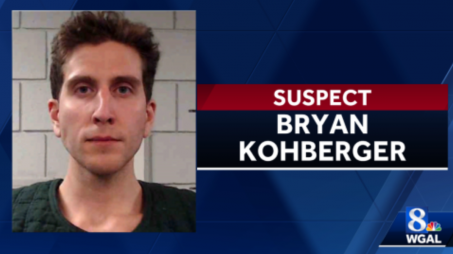
Bryan Kohberger is the suspect and criminology graduate student who is accused in the stabbing deaths of four University of Idaho students, who were killed in Moscow, Idaho. Kohberger, 28, was arrested on December 30, 2022, in Monroe County, Pennsylvania, court records show. His name was first confirmed by WPVI, a Philadelphia news station.
The accused man’s full name is Bryan Christopher Kohberger,according to Monroe County court records in Pennsylvania. . . .
Kohberger is facing extradition to Idaho on murder charges, the WPVI news station reports. Kohberger, an Albrightsville, Pennsylvania native, is a graduate student at Washington State University in Pullman, Washington, not far from Moscow. According to the WSU website, Kohberger is pursuing his Ph.D in criminal justice and criminology. . . .
The deaths were previously ruled homicides, police said.
“These individuals have been identified as Ethan Chapin, 20, Conway, WA; Madison Mogen, 21, Coeur d’Alene, ID; Xana Kernodle, 20, Avondale, AZ ; and Kaylee GonCalves, 21, Rathdrum, ID,” Moscow, Idaho, police wrote in a statement. The cause of death was homicide by stabbing. . . .
When Kohberger was arrested, he “asked if anyone else was arrested,” [reporter Brian] Entin wrote in a tweet, adding, “I’m told he had a ‘quiet, blank stare.’” . . . According to the NBC Philadelphia story, which broke on December 30, 2022, Kohberger was “taken into custody near the Pocono Mountains” in connection with the November 13, 2022, Moscow homicides. . . .
Kohberger . . . obtained a master’s degree from DeSales University, according to a commencement document from DeSales, which is located in Center Valley, Pennsylvania. . . .
Kohberger is listed on Meritpages.com as being a graduate of “Northampton Community College, Class of 2018” and “From Albrightsville, PA.” That website says that he made the dean’s list at Northampton, where he was studying “Liberal Arts, Psychology,” according to Meritpages.com.
UPDATE: The fact that Kohberger was attending grad school at Washington State University, just eight miles from the University of Idaho campus where the four students were murder in November, is certainly intriguing. Some had also previously suggested that the Idaho murders were the work of a serial killer, tying them to unsolved stabbings in Silverton, Oregon, and Washougal, Washington.
Bryan Kohberger's criminal complaint shows he was arrested in Pennsylvania on an active arrest warrant for murder in the first degree, issued through the Moscow Police Department and Latah County Prosecutor's Office. He awaits extradition to Idaho.#MoscowHomicides@IdahoNews6pic.twitter.com/ecsbAivFkQ
UPDATE II: Well, the police in Idaho held a press conference, but because the suspect has not yet been arraigned, they couldn’t divulge anything about the case except (a) they haven’t found the murder weapon yet and (b) a white Hyundai Elantra, matching the description of a vehicle seen near the murder scene at the time of the crime, was seized at Kohberger’s Pennsylvania residence. So we don’t know how the cops broke the case, or what evidence they have against Kohberger, and won’t learn more until after the suspect is extradited to Idaho and gets arraigned, at which time we’ll see the affidavit.
A relative told The New York Post Kohberger is ‘OCD’ about his eating habits and forced his family to buy new pots that had never been used to cook meat.
‘It was above and beyond being vegan. His aunt and uncle had to buy new pots and pans because he would not eat from anything that had ever had meat cooked in them. He seemed very OCD (obsessive-compulsive disorder)’ the woman said. …
Law enforcement sources told CNN that his DNA was discovered at the scene of the crime – with officers managing to track down who owned the car seen in the area of the slayings.
However, Kohberger has no prior arrests, according to public records, so it is unclear how officials got hold of his DNA.
Authorities then discovered that he had left the area and traveled to Pennsylvania, where an FBI surveillance team had been tracking the 6ft tall man.
He was kept under surveillance, with the FBI watching him for four days, while investigators from Moscow Police and Idaho State Police worked to get an arrest warrant. . . .
Nick Mcloughlin, who was friends with Kohberger [in high school] told the Daily Beast he was ‘stunned’ to see his old acquaintance arrested.
Mcloughlin said Kohberger was ‘down to Earth,’ when he graduated junior year. But at the start of senior year, Kohberger returned ‘thinner than a rail,’ had turned ‘aggressive’ and taken up boxing.
Recalling how their friendship soured, Mcloughlin added: ‘He always wanted to fight somebody, he was bullying people. We started cutting him off from our friend group because he was 100 percent a different person.’
[Mcloughlin] said he has ‘no idea’ what prompted the sudden change. . . .
The murderer is a vegan? Round up all the vegans! Lock them away! No one is safe from the violence of these killer vegan maniacs!
“I write separately to express my views on the topic of hate speech, disturbingly present in both the facts of the case before the panel and regrettably, a reemerging threat to society throughout the nation today. . . . The continued prevalence of hate speech and crimes against American citizens and residents on the basis of race, ethnicity, religion, sexual orientation, gender identity, and disability is evidence of the enduring threat of hate crimes to the fabric of American democratic society and to the safety and security of individuals.”
What bothers me most here is that casual conflation of (a) “hate speech” with (b) “hate crimes,” suggesting that suppression of (a) will prevent (b), a suggestion offered without evidence. And it is my belief that, not only is this false, but that the opposite is true, i.e., that there is likely to be more violence motivated by “hate” if people are forbidden to express whatever resentments and grievances might inspire such violence.
In November 2016, at the suggestion of a friend, [plaintiff] Epple created a private Instagram account to share comments “privately with my small group of friends.” . . .
Chen “followed” the account using the Instagram username “kkkevinkkkkk.” Chen likewise understood that Epple’s second Instagram account was to “be a private forum (by invite only), exclusive to [their] friends, and a place where [they] could share sarcasm, jokes, funny images, and other banter privately.” Not all of the persons who eventually followed the account knew who the owner of the account was.
Between November 2016 and March 2017, Epple used the account to make a number of cruelly insulting posts about various AHS students. These ranged from immature posts making fun of a student’s braces, glasses, or weight to much more disturbing posts that targeted vicious invective with racist and violent themes against specific Black classmates. For example, in early February 2017, Epple uploaded a photograph in which a Black member of the AHS girls’ basketball team was standing next to the team coach, who was also Black, and Epple drew nooses around both their necks and added the caption “twinning is winning.” In another post, he combined (1) a screen shot of a particular Black student’s Instagram post in which she stated “I wanna go back to the old way” with (2) the statement “Do you really tho?”, accompanied by a historical drawing that appears to depict a slave master paddling a naked Black man who is strung up by rope around his hands. On February 11, 2017, he posted a screenshot of texts in which he and a Black classmate were arguing, and he added the caption “Holy shit I’m on the edge of bringing my rope to school on Monday.” Other posts, although not referencing specific students, contained images either depicting, or making light of, Ku Klux Klan violence against Black people. One post included what appears to be a historical photograph of a lynched man still hanging from a tree; another depicts a Klan member in a white hood; and a third combines the caption “Ku klux starter pack” with pictures of a noose, a white hood, a burning torch, and a Black doll.
Epple also created several posts that, while omitting references to violence, still aimed highly offensive racist insults at identifiable Black classmates. In one, he uploaded an image of a Black student sitting in class that was captioned with the statement “The gorilla exhibit is nice today.” . . .
The issue before the court was whether the school could expel students based on private communications that happened off-campus, a relatively narrow question about the limits of public school disciplinary policy. What is of interest to me, however, is what the behavior of these students says about the apparent presumption of the Circuit Court judge who thinks that censoring “hate speech” is the best way to deal with what he calls “a reemerging threat to society.” As if California public schools weren’t already in the iron grip of wokeness?
Isn’t it likely that these teenagers were pursuing the thrill of defying authority — the frisson of rebellion — by expressing beliefs and attitudes they knew were forbidden? Maybe these kids aren’t actually any more racist than their classmates, but instead are just doing what adolescents have always done, rebelling against the prevailing social norms which, in Alameda County, are those of uber-woke liberalism.
While it is certainly not my intention to defend such behavior — crude and deliberately offensive “jokes” — or even to argue against expelling these students, it seems to me that the facts of the case contradict the Ninth Circuit judge’s argument in favor of more aggressive suppression of “hate speech.” It’s not as if Epple and Chen were doing this in an environment of tolerance toward expressions of racism — quite the opposite. So, the judge seems to be arguing, the answer to acts of rebellion against repression is . . . more repression?
Count me as skeptical — or call me a RAAAAACIST! for doubting that more stringent political correctness will solve anything.
One of the difficulties of trying to get Americans to understand our nation’s crime problem is that most people don’t acknowledge the existence of the category “criminals.” That is to say, because of the way crime is portrayed in entertainment and news media, there seems to be a widespread belief that criminal behavior is more or less randomly distributed throughout the population, so that practically everybody is equally at risk of being a crime victim or, perhaps, perpetrating a crime. However, anyone who actually researches crime will discover that a majority of serious criminal offenses are committed by a comparatively small group of repeat offenders — career criminals, the kind with the proverbial “record as long as your arm.” You could reduce the crime rate by more than 50% simply by identifying these offenders and locking them up and, in such cases, prosecutors should treat these repeat offenders according to what I’ll dub “The Al Capone Principle.”
Al Capone was the most notorious Mafia boss of the 1920 and ’30s, whose gang committed innumerable robberies, hijackings and murders, along with many other lesser crimes — bootlegging, pimping, extortion, you name it. Getting witnesses to testify to Capone’s crimes was problematic, because any witness was likely to be killed or terrorized into silence before the case went to trial. This led to the ironic consequence that, when Capone was finally sent to federal prison, it wasn’t for any of the many acts of brutal violence he had committed, but instead for evading federal income taxes. And this, I say, is the secret to reducing crime: Once you figure out who the criminals are, it doesn’t matter what offense you convict them for, so long as they’re put behind bars for a long, long time.
Well, “mass incarceration,” say the Social Justice Warriors — America is racist and too many black men were in prison, and so activists demanded policies to change this. The problem is that, from a public-safety perspective, “mass incarceration” worked. Prior to the Ferguson riots, the U.S. homicide rate had declined drastically for more than 20 years, from a peak of 9.71 per 100,000 in 1991 to 4.44 in 2014 — a 57% reduction. Several factors were involved in this remarkable public-safety success story, among them mandatory minimum sentencing guidelines that sent drug dealers to prison for many years. Cry all you want about the “War on Drugs” leading to racial injustice, the fact is that a lot of violence was being perpetrated by urban gangs involved in drug trafficking, so that putting gang-bangers behind bars on drug charges had a correlated effect of reducing violent crime — “The Al Capone Principle” in action.
Mandatory sentences for drug crimes weren’t the only factor involved in this two-decade-long reduction of criminal violence, however. A lot of it had to do with how technology made it easier to apprehend and convict criminals. Surveillance video, DNA analysis, computerized fingerprint databases — beginning in the 1990s, cops and prosecutors began to acquire more and more tools to help them identify perpetrators and prove their guilt. Consider one of the biggest stories about public safety in the 1990s, the application of so-called “Broken Windows” theory in New York City. Social scientists James Q. Wilson and George Kelling are credited with popularizing the idea that by enforcing laws against “quality of life” offenses (e.g., vandalism, public intoxication, loitering), police send a signal to the community that has the effect of reducing more serious crimes. Which is no doubt true, but what really made this approach effective in New York City was NYPD’s use of CompStat:
On a weekly basis, personnel from each of the NYPD’s 77 precincts, nine police service areas and 12 transit districts compile a statistical summary of the week’s crime complaints, arrests and summons activity, as well as a written report of significant cases, crime patterns and police activities. This data, with specific crime and enforcement locations and times, is forwarded to the chief of the department’s CompStat Unit, where information is collated and loaded into a citywide database.
The unit runs computer analysis on the data and generates a weekly CompStat report. The report captures crime complaints and arrest activity at the precinct, patrol borough and citywide levels, presenting a summary of these and other important performance indicators.
The data is presented on a week-to-date, prior 28 days and year-to-date basis, with comparisons to previous years’ activity. Precinct commanders and members of the department’s senior officers can easily discern emerging and established crime trends, as well as deviations and anomalies. With the report, department leadership can easily make comparisons between commands. Each precinct is also ranked in each complaint and arrest category.
By compiling crime reports in a database, CompStat gives cops knowledge of what crimes are happening and where on a weekly basis — a computerized roadmap that helps them target enforcement in areas where crime is most common. Many cities across America adopted the approach pioneered by NYPD and, not surprisingly, it turns out that putting more cops where the most crime is happening has a remarkable deterrent effect on criminal activity. If this also results in more black people going to prison, well, “Don’t do the crime if you can’t do the time.”
Crime is not just a statistic, however. Or, rather, statistics are just a compilation of separate events, and if you spend enough time watching police activity videos on YouTube, you begin to see distinct patterns of criminal behavior, which brings us to the case of Teronnie Austin Wade.
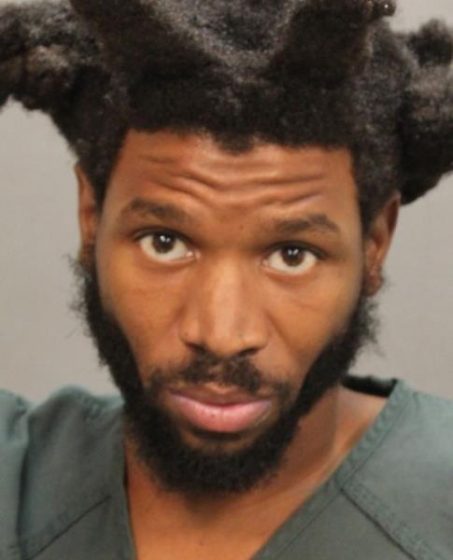
Wade is a lifelong career criminal. In 2014, when he was sentenced to a year in prison after pleading guilty to grand theft auto. In 2017, he was sentenced to three years in prison after pleading guilty to having a gun as a convicted felon. In 2020 — that is to say, almost immediately after his release from prison — Wade was a passenger in a car that was pulled over for a traffic violation. He was found in possession of a handgun, 22 bags of cocaine and the synthetic drug Flakka. At this point, it should have been apparent that Wade was at all times a member of the category “criminal.” At no time since he reached adulthood had Teronnie Wade attempted to make a legal living, but was instead constantly either (a) committing crimes or (b) serving time in prison.
A judge ordered Wade held on a bond of nearly $130,000, but for some reason, that was later lowered to $50,000, and the career felon was released from jail in Jacksonville, Florida. He failed to show up for an October 2021 court hearing, and a warrant was issued for the fugitive’s arrest. So it was that Teronnie Austin Wade next encountered law enforcement at 1 a.m. on Saturday, Jan. 8, 2022. Five people were inside a sedan that made an illegal U-turn at a red light on Lem Turner Road in Jacksonville. When police pulled the car over, Wade was sitting in the front passenger seat. Officers noticed the smell of marijuana and began questioning the occupants:
Officer B then asks the passenger in the front seat to roll the window down. “I don’t talk to the police, sir. I’m a passenger,” the man replies.
“OK,” the officer replies. “Can you just roll the window down for me? You don’t need to talk to me.” “I’m a passenger, sir,” the man replies.
“No, hey, don’t go reaching in your pockets, alright?” Officer B said. “I’m a passenger, sir,” the man repeats.
The officer tells the man it’s OK if he doesn’t want to talk to him, he just wants him to roll the window down.
“Got to talk to the driver, sir,” the man responds.
Officer A then walks back over to the white car to talk to the front seat passenger, who was wearing a bulletproof vest. The officer asks the man if he has a medical marijuana card.
The passenger replies, “Sir, I don’t answer any questions, sir.”
Now, when a police officer notices that a civilian is wearing a bulletproof vest, this naturally arouses suspicion. But before we get to that, let’s examine Wade’s claim that, because he is only a passenger in the vehicle, and not the driver, he doesn’t have to answer the officer’s question. Maybe this is true, in a narrow legal sense, but when you get pulled over in a vehicle that reeks of marijuana, you are then a suspect in a crime unrelated to mere traffic violations. And because these cops weren’t born yesterday — because they are experienced enough to recognize patterns of criminal behavior — there was a good reason why they wanted Teronnie Wade to roll down his window, namely to improve their ability to see inside the car, to see if there were any weapons present.
Criminal activity follows certain patterns, and while the driver of the car claimed that he and his friends had been on their way to Walmart — intending to get supplies to fix another car, only to discover that Walmart was closed — the police suspected there might have been another motive for this trip. Because why were there five guys in this one car, including a passenger who’s wearing a bulletproof vest? None of the officers recognized Wade as a convicted felon, but experienced cops tend to acquire a sixth sense, and so he was taken out of the vehicle, at which point the cop saw the extended magazine of a pistol sticking out of the back of Wade’s pants. Bulletproof vest + pistol = trouble.
What resulted was an “officer involved shooting” (OIS) incident. When officers attempted to handcuff Wade, he broke free and ran, then turned and fired at officers, who returned fire. More than 40 shots were fired in the gun battle, which ended with Wade seriously wounded. He survived, and was charged with two counts of attempted murder of a law enforcement officer, plus possession of a weapon by a felon and resisting arrest. This time, he was held without bail.
This incident is an example of a pattern we have seen repeatedly in recent years — suspects with extensive criminal records, out on bail, committing crimes that cause people to ask, “Why wasn’t this guy behind bars?” Wade’s multiple previous convictions, including being a felon in possession of a firearm, should have been sufficient to convince any judge that this guy was too dangerous to be released after he was busted with drugs and a gun yet again in 2020. Yet there he was, riding around after midnight, wearing body armor and carrying a pistol with an extended magazine, a fugitive who had (predictably) violated terms of his bail.
How is it that the same liberals who bemoan “mass incarceration” also want to lecture us about “gun violence”? As if a policy of turning loose criminals has no impact on the crime rate? As if the gun itself — an inanimate object — were the cause of violence, rather than the criminals that liberals want to turn loose? It is difficult for me to believe that in Florida, which is certainly not a haven of liberalism, a guy who just got out of prison for a weapons charge could have gotten busted with a gun again, and then turned loose on bail. Where is “mass incarceration” when we really need it? This shootout in Jacksonville is, in a way, a microcosm of what’s gone wrong in our criminal justice system in recent years.
“I don’t talk to the police, sir,” says the career criminal, a fugitive with a warrant for his arrest, carrying a pistol with an extended magazine and wearing body armor while he’s riding around at 1 a.m.
This is what “social justice” looks like — armed criminals ready, willing and able to murder the police, because Black Lives Matter, you see.
For a minute I considered having Ingrid Pitt as an appetizer again, since St. Stephen is the patron of casketmakers and Ms. Pitt spent a lot of Hammer movies in caskets, but I thought it was a bit of a stretch…so you get Cikita Pechova, a Czech model I spotted on Reddit. Hope everyone had an enjoyable Christmas. Ceterum autem censeo Silicon Valley esse delendam.
The NFL season is too long. The league’s decision to extend the season from 16 games to 17 was a mistake, as was the decision to expand the postseason playoffs from 12 teams (six in each conference) to 14 (seven in each conference). Under the previous playoff format, the two division champions in each conference with the best records (i.e., the #1 and #2 seeds) got “byes” in the wild-card round, but now only one team in each conference gets that precious bye. And an extra week’s rest really matters because, after playing a 17-game regular-season schedule, every team in the league has its share of injuries, major or minor.
Until last year, when the New England Patriots drafted Alabama quarterback Mac Jones in the first round, I hadn’t paid much attention to the NFL. But the idea of a ’Bama boy being tapped to fill the gigantic shoes of all-time great Tom Brady fascinated me, and having seen Jones lead the Crimson Tide to an undefeated National Championship season, I felt he was up to the challenge. The fact that he beat out former MVP Cam Newton for the starting QB job in New England, and led the Patriots to the playoffs as a rookie, seemed to confirm my judgment. Of course, the Patriots were “one and done” in the playoffs last season, and they have suffered all sorts of struggles this year — Mac Jones missing four games with an ankle injury, amid a misguided revamp of the team’s offensive scheme — but I still believe Mac is destined for NFL greatness.
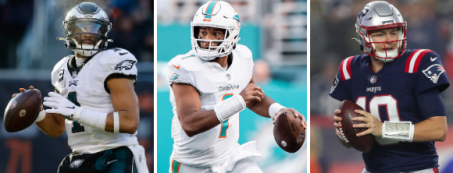
Jones isn’t the only former Alabama quarterback in the league, however. At one time, Mac was the third-string QB for the Crimson Tide, when Jalen Hurts was the starter and Tua Tagovailoa was the No. 2 QB. Hurts had been the starter for the 2016 team that made it all the way to the National Championship game before losing to Clemson, and returned for the 2017 season, with Tagovailoa, a freshman recruit from Hawaii, beating out Jones for the No. 2 spot. That year, Alabama lost to Auburn, which cost them an appearance in the SEC title game, but the Tide made it into the national playoffs as the No. 4 seed, then upset top-seeded Clemson to make it to the championship against Georgia. That was one of the greatest games in Alabama’s long and glorious football history. At halftime, the Bulldogs led 13-0 and Coach Nick Saban made a shocking choice — the true freshman Tua Tagovailoa would start the second half. Tua did not disappoint, throwing for 166 yards and three touchdowns, leading the Crimson Tide to an exciting 26-23 overtime victory.
Tagovailoa remained the starter for ’Bama the next season and, although Hurts continued to see significant playing time as a backup, after 2018 he transferred to Oklahoma, where he passed for 3,851 yards, ran for another 1,298 yards and led the Sooners to the Big 12 conference championship. In 2020, both Hurts and Tagovailoa entered the NFL draft, where Tua was a first-round pick (fifth overall) for the Miami Dolphins and Hurts was a second-round pick (53rd overall) for the Philadelphia Eagles. Both Tua and Jalen had their struggles during their first two NFL seasons, but this year Hurts emerged as one of the most dynamic QBs in the league, passing for 3,472 yards and 22 touchdowns, adding 747 yards and another 13 TDs rushing. At 13-2, the Eagles have the best record in the NFL and are one win away from clinching the NFC East title, although Hurts has been sidelined after spraining his left (i.e., non-throwing) shoulder against Chicago in Week 15.
Meanwhile in Miami, after starting the season 8-3, the Dolphins have hit a four-game losing streak, including a Christmas Day defeat at home against Green Bay, when Tua threw three interceptions as Aaron Rodgers led the Packers to a 26-20 comeback win. Before the streak, the Dolphins looked like they might displace the Buffalo Bills as AFC East champions; now the Bills have clinched, and Miami is fighting for a wild-card playoff spot, a competition that will be highlighted on New Year’s Day, when Tua and the Dolphins play Mac and the Patriots in Foxborough. Both Miami (8-7) and New England (7-8) have lost four of their last five games — the Patriots haven’t won since beating the Arizona Cardinals on Dec. 12 — and, regardless of how the outcome affects the playoff scenario, there will be a definite factor of self-respect at stake for both teams.
Every team in the league is now banged up and had their lineup reshuffled since the season began. For example, look at the San Francisco 49ers, who have clinched the NFC West title with an 11-4 record. The Niners began the season with Trey Lance, a 2021 first-round pick, at quarterback. In the second game of the season, however, Lance suffered a broken ankle, and veteran Jimmy Garoppolo stepped in at QB. Jimmy G was good enough that San Francisco took a 7-4 record into their Dec. 4 road game at Miami, where Garoppolo suffered a broken foot on the opening drive. That left the 49ers to bring in rookie Brock Purdy at QB. Purdy was the very last player chosen (7th round, 262nd overall) in this year’s draft, and the idea that this low-rated prospect out of Iowa State would become the starter his rookie year was a million miles away from anything San Francisco coach Kyle Shanahan had in mind.
Wow, a late-round draft pick stepping in at quarterback because of injuries — doesn’t that story seem kind of familiar?
With Purdy at QB, the Niners are undefeated, having won five in a row, and they’re unlikely to lose their last two games, against the Raiders and Cardinals, so that this long-shot obscurity — a kid that almost nobody thought had a chance to make it in the NFL — now appears ready to lead a division champion in the playoffs. And the toll that injuries have taken during this long season can be seen in the rosters of all the playoff teams, several of which will go into the postseason with players in their starting lineups who began the season on the practice squad.
The season is just too damned long, and any player who makes it through 17 games without a significant injury is just lucky. All three of the former Alabama QBs starting in the NFL this season have missed games with injuries, and the fortunes of the Philadelphia Eagles — the team with the best record in the league — hinge on whether Jalen Hurts can come back from his shoulder injury at full strength for the playoffs. As my brother Kirby has pointed out, the new rules surrounding concussions guarantee that many top players, including quarterbacks, will be forced to sit out at least one game during the year. Should the team owners and the players union try to make a new agreement to increase roster sizes, to ensure that teams have enough depth to be able to make it through the season? And wouldn’t it make sense to admit that the 17-game schedule was a mistake? Go back to 16 games and, while you’re at it, go back to the 12-team postseason playoffs. As much as we hate to admit it, we have learned that there is such a thing as too much football.