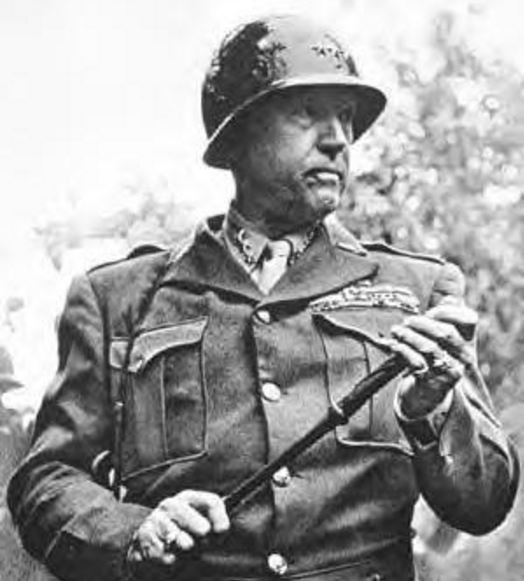
“Americans traditionally love to fight. All real Americans love the sting of battle. . . . Americans love a winner and will not tolerate a loser. Americans play to win all the time. . . . Because the very thought of losing is hateful to Americans.”
— Gen. George S. Patton, 1944
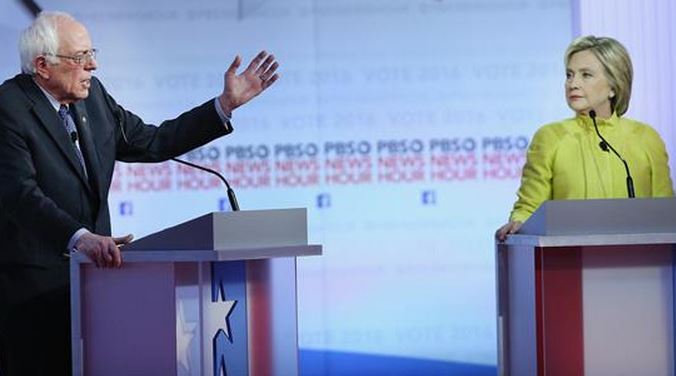
Today, there is encouraging news for Republicans. The latest NBC tracking poll shows Donald Trump closing in on Hillary Clinton:
While Clinton is looking to wrap up the Democratic nomination with a strong performance in the final group of states on June 7, her advantage in a hypothetical matchup against the Republican nominee has dwindled by the week. Over the last seven days, Clinton led Trump 47 percent to 45 percent, with the Manhattan businessman drawing 2 points closer since the last weekly survey.
This is mirrored in the Real Clear Politics poll average, where Clinton led by 10 points six weeks ago in mid-April, but is now just a single point ahead of Trump. This is encouraging news, I say, if you are a Republican who considers it imperative to defeat the Democrats. On the other hand, if you are a disgruntled intellectual like David Frum, Trump’s impressive success is a threat to all that is good and holy:
The television networks that promoted Trump; the primary voters who elevated him; the politicians who eventually surrendered to him; the intellectuals who argued for him, and the donors who, however grudgingly, wrote checks to him—all of them knew, by the time they made their decisions, that Trump lied all the time, about everything. They knew that Trump was ignorant, and coarse, and boastful, and cruel. They knew he habitually sympathized with dictators and kleptocrats—and that his instinct when confronted with criticism of himself was to attack, vilify, and suppress. They knew his disrespect for women, the disabled, and ethnic and religious minorities. They knew that he wished to unravel NATO and other U.S.-led alliances, and that he speculated aloud about partial default on American financial obligations. None of that dissuaded or deterred them. . . .
You can read the whole thing, if you’re into that kind of totally demoralizing Voice-of-Doom trip. David Frum hates Donald Trump about as much as does former Hillary adviser Alec Ross, who called Trump “a vulgar, demented, pig demon.” There is a bipartisan consensus against Trump among the decadent intellectual elite, while among the electorate — you know, the actual citizens of America who elect presidents — there is a bipartisan consensus that we need to stop listening to the intellectual elite. It seems a substantial segment of the electorate have decided that the “experts” got us into this mess, and so to hell with the experts.
Is it my job to tell the America people they’re wrong? No, because I actually agree with this anti-elite consensus and the fact that the chosen messenger, Donald Trump, is far from ideal in many ways does not alter the basic politica goal, i.e., defeat the Democrat Party.
We must fight the war we are actually in with the army we actually have.
Now is not the time — scarcely five months before Election Day — to sit around bemoaning the accumulated problems of the GOP political apparatus that made it impossible for conservatives to nominate some other candidate that they might have preferred over Trump.
Honestly, a year ago, it seemed to me that Wisconsin Gov. Scott Walker was the man to beat, but he didn’t catch fire in the early debates and was the first candidate to quit the primary race. So much for my own “expert” opinion, I suppose. When he quit the campaign, Walker urged others in the crowded primary field to emulate his example, in order to unite behind a non-Trump candidate. Yet 11 candidates went all the way to the Iowa caucus in February, with eight candidates (Ben Carson, Rand Paul, Jeb Bush, Carly Fiorina, John Kasich, Mike Huckabee, Chris Christie and Rick Santorum) divvying up about 25% of the vote, which might otherwise have gone to either Ted Cruz (who narrowly won Iowa) or Marco Rubio, who placed third in the caucuses. How different might the outcome of the primary campaign have been, if Cruz had won Iowa more decisively and Rubio had finished second, with Trump third? I don’t know, but nearly three weeks later, when Trump decisively won the Feb. 20 South Carolina, only five other candidates (Rubio, Cruz, Bush, Kasich and Carson) were still running, and defeat in South Carolina ended the campaigns of Bush and Carson.
Could this winnowing of the GOP field have been done much earlier? Yes, but do you think any of the consultants and campaign operatives on the payrolls of Team Bush — which raised $162 million — were going to tell Jeb that his candidacy was a waste of time and money? Or what about the various political “experts” hired by the campaigns of Carson, Kasich, Christie, Fiorina, Rick Perry and Bobby Jindal who between them raised a combined total of more than $200 million? Wasted money, wasted time, and nothing meaningful to show for it. All in all, about $400 million was squandered on the ultimately futile campaigns of Republican candidates who didn’t make it past South Carolina, and did anyone seriously believe John Kasich’s extended candidacy could help stop Trump in the much-talked-about “brokered convention” scenario?
Well, all that is now decisively over, and Bill Kristol is now publicly fantasizing about a third-party candidate — an idea perhaps slightly less realistic than a teenage boy’s wet dreams about Kate Upton.
Simple question: Do we want to beat Hillary, or not?
It is evident from the polls that Donald Trump can beat Hillary, and if some of our conservative pundit friends can get over their hurt feelings over their failures in the GOP primary campaign, maybe Trump will beat Hillary. But if we wake up the morning after Election Day and find that Hillary Clinton has been elected president because some disgruntled Republican “strategist” types didn’t do all they could to help beat Hillary, there is going to be hell to pay. The very thought of losing is hateful to Americans, and a victory for Hillary is a defeat for America.
Let’s win this thing.