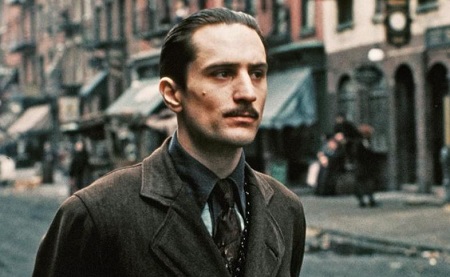
In March 1975, Robert De Niro was 31 years old when he won the Oscar for Best Supporting Actor for his breakthrough role as young Vito Corleone in The Godfather, Part II. Leslie Mann was barely 3 years old at the time, and there was something distinctly weird about Mann, now 44, being cast as De Niro’s love interest in The Comedian. How do you write a romantic comedy with a 73-year-old leading man? To be honest, the smart answer to that question is, don’t even bother trying.
Let me put it another way: In 1981, Henry Fonda was 76 when he scored an Oscar for On Golden Pond, in which he played an old man whose wife was Katharine Hepburn, then age 74. Robert De Niro may be in better health at age 73 than Henry Fonda was at age 76, but it is still asking too much of audiences to foist upon them a septuagenarian leading man who wins the heart of a woman young enough to be his daughter.
Far be it from me to encourage the feminist grievance-mongers who so often complain about how actresses suffer discriminatory treatment because middle-aged male movie stars continue to be cast in leading roles, whereas there are far fewer lead roles for actresses over 40. It is not the sexist bias of movie producers that accounts for this disparate treatment, but rather the tastes of movie audiences. If you want to make big money in Hollywood, the question you are constantly trying to answer is, What will the typical 15-year-old boy pay money to see at the suburban multiplex? (Answer: Definitely not Meryl Streep.)
Do the Hollywood studios want to make money or do they want to make art? Well, it can be argued, they want to do both, but the idea behind this latest De Niro movie seems to have been a make-work project for old actors, and not a very clever idea as such projects go. It is possible to make great movies about old people, e.g., Walter Matthau won Best Actor for his role in The Sunshine Boys, and Jessica Tandy won Best Actress for her role in Driving Miss Daisy. However, neither of those films tried to place the elderly protagonist into a boy-meets-girl romantic-comedy plot. Such a plot simply doesn’t work as a narrative arc with mass audience appeal, and no 15-year-old boy is going to buy that ticket at the multiplex.

Leslie Mann and Robert De Niro in ‘The Comedian.’
The idea behind The Comedian was a “development” project for nearly 10 years, and four different writers are credited for the script:
It all began with a funny idea. After working on a movie with Mr. De Niro called “What Just Happened,” the producer and screenwriter Art Linson suggested they collaborate on a movie about a comic who makes the woman he’s roasting laugh so hard she dies. . . . “That excited me,” Mr. De Niro said. “You get one scene, and you want to do the whole movie.”
That was a decade ago, and exactly why this idea for one scene should inspire an entire movie is a mystery. Yet the real question is why so much effort would be expended to push The Comedian forward, despite all the omens warning that the movie was destined for Flop City.
How an Oscar-Bait Scheme Went Wrong
Go ask around Hollywood. If a top producer like Art Linson can get an Oscar-winning actor like Robert De Niro sold on an idea for a movie, it’s never going take 10 years to make that project happen. At one point, Sean Penn had agreed to direct The Comedian, and it’s hard to imagine a studio executive presented with such an all-star package deal saying, “No, let’s don’t make that movie” — unless the basic idea was utterly stupid.
Critics don’t want to say bad things about a project like this, which got a limited release in December on the outside chance of getting an Oscar nomination or two. That’s a big clue to the industry insider thinking behind The Comedian. Linson and De Niro really wanted to make a movie called “Let’s Get Another Oscar for Robert De Niro,” but what they made instead was, “Let’s Watch Robert De Niro Lose His Dignity.”
We may stipulate, arguendo, that the idea of a once-popular comedian trying to make a comeback could make for a good movie, as this was the basic plot of The Sunshine Boys. However, that was a Neil Simon script, and both of the stars of that movie — Matthau and George Burns — were known primarily for their comic roles. Perhaps what inspired Art Linson to think he could do something like that with De Niro in The Comedian was De Niro’s role as a delusional stalker in The King of Comedy, but that was a very dark drama directed by Martin Scorcese. Certainly, De Niro is capable of being funny (e.g., father of the bride in Meet the Fockers), but the problem with The Comedian is not the star, it’s the story.
David Sims at The Atlantic gets to the heart of the problem:
Early on, [De Niro’s character] Jackie gets in an altercation with a heckler at a standup set and punches him; given the chance to apologize by a judge, he refuses and goes to prison. Stuck doing community service, he meets Harmony (Leslie Mann), a fellow self-loathing miscreant that he immediately falls for, despite their 29-year age difference. Unfortunately, that necessitates dealing with her father Mac (Keitel), some sort of retired mobster with a serious attitude problem. . . .
It’s almost like The Comedian is trying to distract from the inherent ridiculousness of its central romantic pairing by throwing celebrity cameos and grumpy mobsters at the audience.
What’s going on here? Wishful thinking.
Art Linson is 74 and the director, Taylor Hackford, is 72, and so you’ve got these old guys who expect the audience to believe that a guy in his 70s can score with a woman 30 years younger. This idea is not beyond the realm of possibility, but it isn’t the kind of story that most people are going to enjoy paying $8 to see at the cineplex. Only if we suspect that the purpose of this project was to grab an Oscar (which is why they got Helen Mirren’s husband to direct it, and filled the supporting cast with a bunch of Academy members) can we begin to understand the existential rationale of The Comedian — a movie about show business, whose intended audience was the show-business people who vote for the Oscars.
OK, so you may be wondering by now why I’ve expended a thousand words analyzing a movie you weren’t going to pay $8 to watch anyway. And the answer is that what’s wrong with The Comedian is the same thing that’s wrong with the media coverage of President Trump. Continue reading Bad Movies and Robert De Niro (and Why Donald Trump Is Not Literally Hitler) →