

“God help us if she ever gets raped — we will be buried under an avalanche of rhetoric.”
— James Wolcott, letter to the Village Voice, 1971
Little Miss Attila vowed Monday that she owes me an essay in response to a post I wrote, and she can write a damned book for all I care. Having begun by insulting me — “fiddle-faddle”! — she has repeatedly doubled down every time I’ve defended myself, and keeps treating my defenses as if they were acts of aggression: How dare you deny your inferiority!
This obviously isn’t about me, but about her, and I cannot be responsible for her feelings of indignation at my refusal to kowtow.
What began the dispute (those few who have followed it will recall) was my attempt to briefly recount the history of feminism, locating it as a movement of the Left. In particular, I called attention to Betty Friedan’s Communist history as evidence of feminism’s ideological orientation. Attila responded by throwing out the name Gloria Steinem as an “a-ha!” But this did not disprove feminism’s left-wing origins, as I explained, because Steinem was a somewhat opportunistic Janey-come-lately to the Women’s Liberation movement that began in 1967. It was not until 1969, when Steinem wrote a New York magazine article about this burgeoning movement, that she became publicly associated with the cause.
Given the fact that the actual founders of Women’s Liberation were all closely associated with the anti-war ’60s New Left — including SDS members and several “Red Diaper babies” like Kathie Amatniek, raised by Communist parents — how on earth could a reference to Steinem be thought to refute my original point? (And, it must be noted, Steinem was herself an anti-war liberal, having supported first Eugene McCarthy and then RFK in the 1968 Democratic primaries.)
Attila seems to have presumed my writing about feminism could only be based in ignorant sexist prejudice: No man could be both (a) informed about the history of feminism and (b) an anti-feminist. Thus I eventually felt obliged to mention that I was writing with a copy of Susan Brownmiller’s memoir In Our Time sitting on my desk.
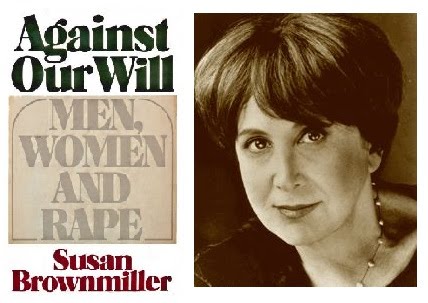 Brownmiller is most famously the author of Against Our Will: Men, Women and Rape, and was one of the organizers of a seminal January 1971 anti-rape “speak-out” event and a subsequent May 1971 Conference on Rape, both sponsored by New York Radical Feminists. The quote from James Wolcott that began this post is from a letter he wrote, as a college student, to the Village Voice in response to Brownmiller’s article, “On Goosing.”
The inspiration for that article was that Brownmiller had been helping pass out handbills to promote the rape conference when she was groped by a passing stranger. Well, as the feminists taught us, “The personal is political” (a slogan that Brownmiller explains was coined by her feminist friend Carol Hanisch). And so this incident led her to write a mini-manifesto of sorts, to which Wolcott supplied the rejoinder.
If my blog-feud with Attila has done nothing else, it has inspired me to re-read In Our Time. Perhaps I should explain how I came into possession of the book. Years ago, when I worked at The Washington Times, I was a voracious scavenger grabbing up books from the “discard” pile in the newsroom. Publishers flooded the book review editor’s office with their latest volumes, only a fraction of which were ever mentioned in the paper. The leftovers were picked through by the book editor and his assistant and what they didn’t want, they brought down from their office upstairs and dumped on a table in the newsroom.
Being a maniacal bibliophile, I would scoop up everything that seemed even slightly interesting to me. And it was through this process that I amassed a small collection of feminist memoirs.
For some reason, the years 1997-2001 unleashed a torrent of such works. Most were by obscure writers who, I guessed, were hoping to get their books onto the reading lists of university Women’s Studies programs. Skimming through the books during train-and-bus rides home, I discovered that most of these stories had a predictable narrative arc: Young woman goes to college; sleeps with boyfriend; has abortion; breaks up with boyfriend; gets involved with anti-war protests; is sexually exploited by a series of boyfriends from the anti-war movement; becomes involved in Women’s Lib; and, at some point past the prime of her promiscuous youth, discovers that she is in fact a lesbian.
The personal is the political, you see, and by the mid- to late 1990s, the personal was also frequently published, as these middle-aged Baby Boomer women felt compelled to share with a waiting world the tales of their “journey” — God, how they over-used that phrase — toward feminist (and usually also lesbian) enlightenment. Continue reading Re-Reading Susan Brownmiller
Confronting the Radical Facts of Feminism →


