“The stigma around STDs normally makes people think of cheaters, liars, teenagers who don’t know any better, and other various ‘dirty’ things when they think of sexually transmitted diseases. But there’s a new name circulating in the news lately who’s trying to battle this stigma: Ella Dawson.”
— Torii Johnson, April 30, 2015
Once upon a time, psychology was about helping people cope with the difficulties of life, to become “well-adjusted” to adulthood. Within my own lifetime — and I could cite my personal experience — practitioners of psychology sought to locate the “root cause” of behavioral problems in order to help people understand why they had the problems they had. This was the justification for what used to be called the “couch trip” of mid-20th century psychoanalysis. In his memoir New York in the Fifties, Dan Wakefield recounts how it seemed that everyone in his circle of young intellectuals was being treated by an analyst:
“Finding yourself” was the overall hope, the grand purpose of Freud’s method of treatment for the human condition, and those of us who entered it thought of the process as noble and ennobling, a search for the truth through painful dark passages of the past, a delving into the heart of the matter, whatever the psychic pain. The idea that the truth was buried, that the nub of our angst and disorientation was hidden like some precious stone in the tar pits of our earliest childhood memories, spoke to us in literature and art.
The Gospel of Sigmund, as we might call this attitude of reverence toward Freudian concepts (as popularly understood) gained a cult-like grip on the 
 minds of bright young liberals like Wakefield. If you want to find the origins of the wild tumult that burst forth in the 1960s, a careful reading of Wakefield’s account of New York in the Fifties might help you understand this. The popularity of Freudianism among intellectuals in the 1950s could be seen as symptomatic of an existential crisis among secular liberals who, having abandoned Judeo-Christian belief as the roadmap by which to guide their lives, found themselves in need of a substitute religion. In a godless universe, people needed some sense of purpose in life, and “finding yourself” was it for the devotees of this Cult of the True Self.
This was really a celebration of narcissism. Ace of Spades summarized a typical latter-day result: “I gotta be me, as the douchebag credo goes.”
Few people understood the danger of this in the 1950s, when America had just won the Second World War and was coping with the major geopolitical and military problems of the Cold War. It was not until the next decade — when a generation of youth went off to college with this goal of “finding yourself” planted firmly in their minds — that suddenly everything seemed to go haywire. “Finding yourself” for many of these people turned out to require disrespect for authority, a rebellion against law and morality, an attitude that in the 1950s had been foreshadowed by the bohemian decadence of the so-called “Beat” writers like Allen Ginsberg, William S. Burrows and Jack Kerouac. Somehow this hedonistic nihilism — the “if it feels good, do it” mentality — got mixed up in radical politics, so that New Left leaders of the Students for a Democratic Society (SDS) coined the motto, “Smash Monogamy,” engaging in orgies as a supposed means to revolutionary “liberation.”
All of this, as I say, originated with the psychoanalytic obsession, that “search for the truth through painful dark passages of the past” as Wakefield described it, which was how Freudianism was understood by the secular intellectuals who popularized the Cult of the True Self.
Because I was always skeptical toward Freud — all that “Oedipus complex” nonsense and so forth — I’ve sometimes found myself arguing with people who will assert that it was not Freud himself who was so wrong, but rather that his theories were misunderstood and that what flourished after his death was a corrupt forgery of actual Freudianism. This is partly true, and partly false. On the one hand, it is true the silly quest for “finding yourself” described by Wakefield was not what Freud himself sought to foist upon the world. On the other hand, you cannot deny that Freud planted the seed from which the massive tangled weed of “pop psychology” sprang up in 20th-century America. Attempting to exculpate Freud for the real-life consequences of his ideas is like claiming that Marx was not to blame for the evil deeds of Stalin and Mao.
During the Cold War, there were always socialists who, when confronted with the reality of totalitarian Communist regimes — in Russia, China, Cuba, North Korea, etc. — would insist that this was not really Marxism, that somehow there could be “true socialism” without a repressive police state to enforce it. Likewise, the defenders of “true Freudianism” insist that the Viennese quack’s misguided ideas can never be blamed for what has observably gone wrong in the field of psychiatric therapy in the past century. Oh, if only people were so lenient in judging Christianity! Yet every time some televangelist gets caught fooling around, the god-haters exult that the scandal proves how wrong Christianity is, and how everyone who believes in the Bible is a fool or a hypocrite. But I digress . . .
When we strip away the mysticism of “theory” from Freud’s work, we realize that the business of rummaging around in the patient’s childhood (“painful dark passages of the past,” as Wakefield says) was intended not to discover the “true self,” but instead was meant to discover why the patient was so unhappy. What was the origin of the neurosis or whatever it was that had brought the patient to the doctor? The attempt to understand this, from a developmental perspective, was seen as the necessary precursor to helping the patient successfully adjust to his situation in life. And this focus on adjustment — that is to say, learning to “play well with others,” to find a useful place in society and be happy with one’s place — was what psychotherapy was really supposed to accomplish. There are always angry misfits and helpless bumblers in the world, and whatever diagnostic label you apply to people who can’t cope, they can learn to cope better if you can get them to consider why they’re such a messed-up bundle of craziness, and also get them to see the importance of getting their act together so that they stop ruining other people’s lives.
Prior to the 1970s, one commonly heard the term “maladjusted” used to describe the basic problem of people who couldn’t get along with others, or couldn’t successfully manage their own lives. The maladjusted person often has some unrealistic idea of how life should be — e.g., a childish 
 fantasy of “fairness” — and this makes them unable to deal with how life really is. You can read Eric Hoffer’s classic The True Believer to see how these misfits are often drawn to political movements as a means of trying to close the gap of cognitive dissonance between reality and their own mistaken ideals. We have seen this in recent times, with the “Occupy Wall Street” movement,, “Black Lives Matter” and the “campus rape epidemic” hysteria serving as vehicles for the emotional tantrums of maladjusted misfits. People whose lives are a carnival of folly love nothing better than to assemble in mobs with other kooks and weirdos, spewing deranged rhetoric of “social justice,” seeking political power on the basis of their imaginary victimhood.
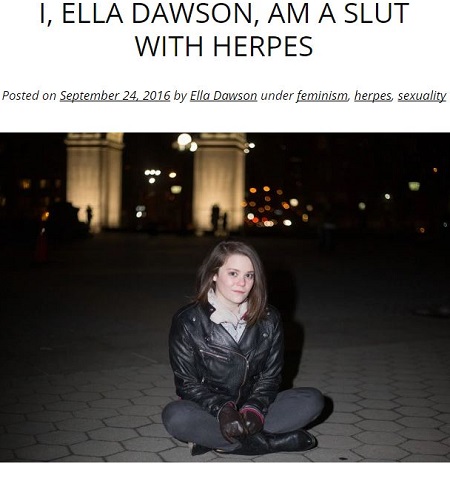
“The fact is the ‘respectable girl from a nice family in Connecticut’ ship has already sailed.”
— Ella Dawson, July 2014
“Finding yourself” — the narcissistic mission of the Cult of the True Self — requires you to believe that the person you actually are is not authentic. If you’re a 24-year-old Gender Studies major with a bad attitude and a herpes infection, working in the non-profit sector, you do not want to believe that this is your True Self because, frankly, you’re a pathetic joke. It seems your destiny is to be lonely and unloved, binge-watching Netflix in a Brooklyn apartment with your cats and your Valtrex prescription. Once upon a time, you were so hopeful and full of potential, a popular student in high school, and when you look back to the once-promising person you were, it’s difficult to understand how far you’ve fallen in a few short years. Oh, but your True Self is innately wonderful, and so you must build mental barricades of rationalization around this concept, to cling to the belief that you are worthy of admiration, and that your own bad decisions were not actually wrong:
I’m bisexual, and everyone knows bisexual women are total sluts. We’re attracted to both genders: we are greedy and slutty. . . .
I am currently non-monogamous, because being able to date any gender is not enough for me. I also need to date everyone. One of these relationships is primarily sexual — we do weird s–t to each other and I call him “daddy” because in addition to being a slut, I am also a bad feminist. I often give my phone number to cute bartenders and flirt with YouTube celebrities on Twitter because not all of my needs can be met by one person, or even two people. I have a lot of needs as a twenty-first century career woman and slut. Everyone knows non-monogamous people are wild as f–k. Sexual exclusivity is so 2013. . . .
During college, I was the editor-in-chief of Wesleyan’s “art and sexuality magazine,” better known as Unlocked Mag. During my tenure, I did two semi-nude photo shoots and was Miss May in our 2014 calendar. I used the line “So how does it feel to f–k the editor of the sex magazine?” at least four times.
I wrote my senior thesis about the activist potential of feminist erotica, and I made a ton of jokes about what kind of research my thesis would require. I f–ked my college boyfriend in my thesis carrel at least once. . . .
I have herpes and thus I am a degenerate slut.
If you’re going to be a degenerate slut, I suppose, you might as well be as flagrant about it as possible, but one cannot build a society on the basis of such behavior. No responsible mother or father would ever want their daughter to become someone like Ella Dawson, nor would any mother or father want their son to date someone like Ella Dawson. She is utterly reprehensible, a toxic stain on humanity, her “feminism” more dangerous to society than her virus-infected genitalia. Continue reading Feminism and the Cult of the True Self →